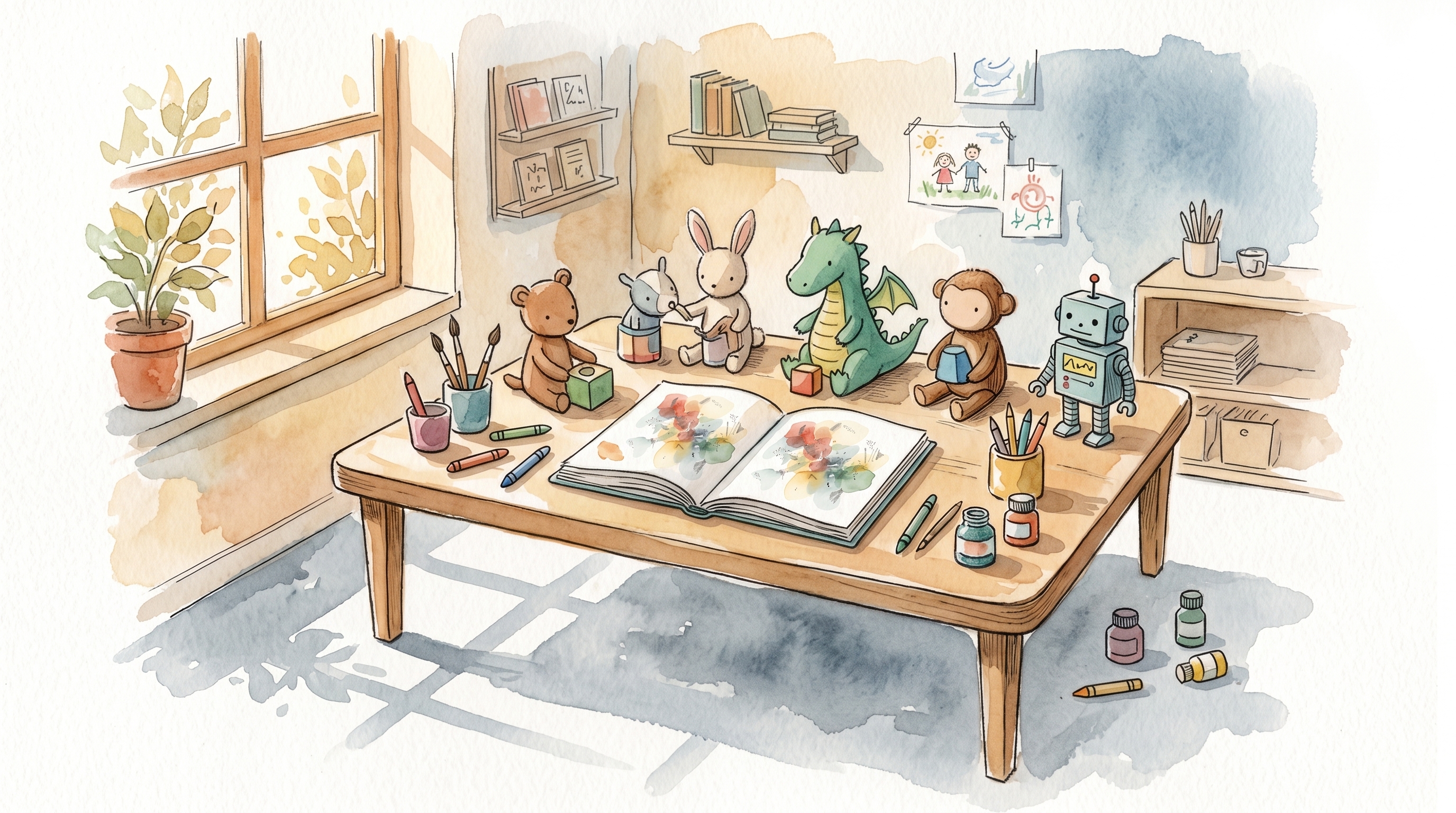
What makes a story truly land with a four-year-old? Often it's the simplest thing: the story is theirs. The hero has their favorite color. The lost puppy turns up behind the very playground they play on. The brave little girl in the book shares a name with the shy one in the back row.
That kind of story isn't on any shelf. Someone has to write it. And that someone should be you.
You're the author. That's the whole point.
Storybench is built around one belief: the words and the imagination are yours. You decide what happens, who it happens to, and how it's told. You're not choosing from a menu of pre-made tales, and you're not handing your story to a machine and hoping for the best. You write it, the way you'd tell it out loud to the children in front of you.
What if the story already fit your class? What if the hero looked like the children you read to, and came back in the next book, and the one after that? What if your only job was to imagine it, and tell it well?
That's the idea. You bring the story. We keep it consistent.
Why consistency matters most with little ones
Three- and four- and five-year-olds notice everything. They'll catch the moment the bunny's ears change shape, or the boy's red jumper turns blue between pages. To a small child that isn't a detail, it breaks the spell. They stop believing it's the same bunny, the same boy, the same world.
So here's the part the AI handles, quietly, in the background: you build your characters once (their faces, their clothes, the places they live), and from then on they show up the same way every time you put them on a page. Your imagination stays in charge. The AI just makes sure the children never lose the thread.
Make the version that suits your children
This is the part we're most excited about. You can take a simple, familiar tale and reshape it for the exact group of children in your room:
- Tell a counting story where the characters are the kids' own favorite animals.
- Make a "first day of school" book that looks like your classroom, so a nervous child sees themselves in it.
- Teach sharing, or kindness, or brushing teeth, with a recurring little hero the children come to know and love across many short books.
- Swap names, places, and lessons so the same story fits this year's class, and next year's too.
Because your cast carries over from one book to the next, that little hero can come back again and again. The children grow up with a friend they recognize, in stories written just for them.
When the book is ready
Print it. You can publish a print-ready PDF for KDP and print-on-demand, an EPUB ebook, or image files of every page, so the story can sit on the reading-corner shelf, live on a tablet, or go home in a note to parents. There's a range of illustration styles to choose from, 2D and 3D, and you don't need to know how to draw a single line.
This is the start
This is our first post, so consider it a hello, and a small promise. We think the people who tell stories to young children (teachers, parents, caregivers) are authors in the truest sense, and they deserve tools that respect that. The imagination is yours. The words are yours. We'll handle the part that keeps your characters whole, so you can get back to the story.
Got a tale you tell the little ones, the one they ask for again and again? Come write it down, your way. We'd love to meet who you bring to life.