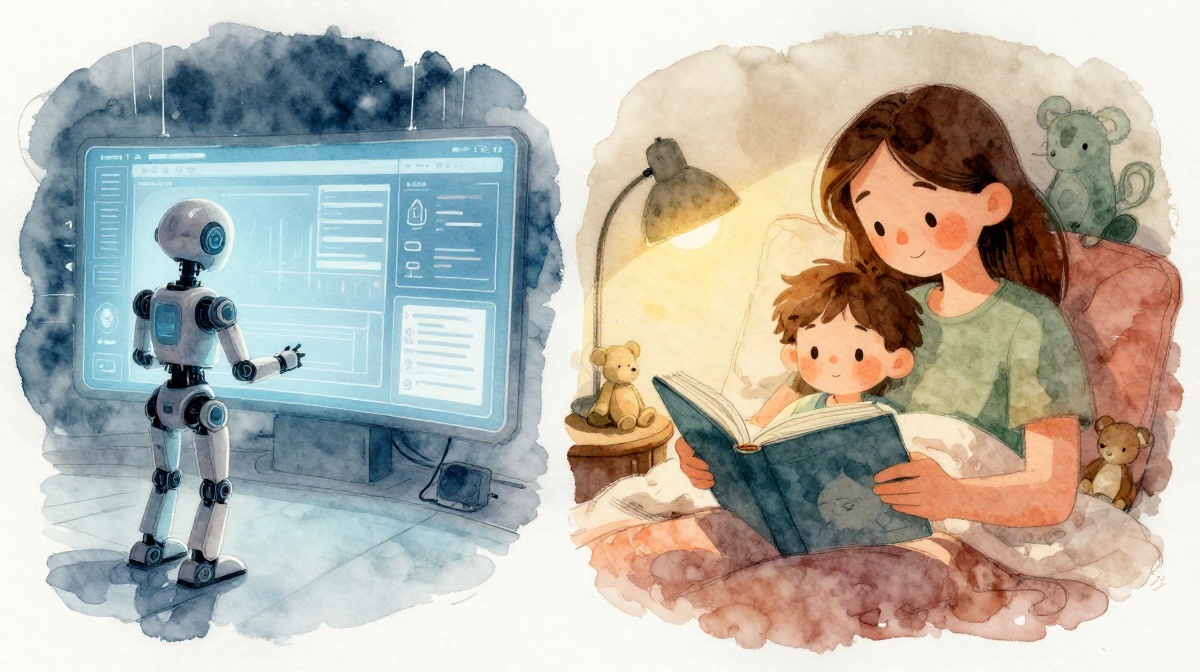
So you want to make a book for your kid, and a model can do it in thirty seconds. Should you let it? The honest answer: let the AI illustrate all it wants, but write the words yourself. A children's book is a relationship, not a deliverable, and the words are the part your kid will actually carry.
That's the whole post, really. But it's worth sitting with, because the easy path is so tempting and so quietly wrong.
Why shouldn't AI write a children's book?
Because a children's book is read out loud, by you, fifty times, to a small person who learns it by heart. The words aren't content. They're the sound of your voice in the dark at bedtime.
A model writes competent, smooth, inoffensive prose. It rhymes when you ask. It never fumbles. And it is forgettable, every single time, because it has no idea who your kid is. It doesn't know that you call broccoli "little trees," or that your daughter named the stuffed fox Pickle and insists Pickle is afraid of the vacuum. The model can't write Pickle. It can only write "a fox."
Smooth and forgettable. That's the trade you make when you let it write.
But isn't my writing not good enough?
Here's the objection we hear most, so let's take it head on. You think you're "not a writer," and you think that disqualifies you. It does the opposite.
Picture books don't reward fancy prose. They reward a plain, true voice and a few words that sound right read aloud. The best line in your book might be six words long. It might be a thing you already say to your kid every day without thinking about it. Write how you talk. Keep it short. Read it out loud, and if it sounds like you, it's done.
The small imperfections are a feature. The slightly-off rhythm, the inside joke, the oddly specific detail, those are the fingerprints. A generated story sands all of them off.
So what is the AI actually for?
Drawing. That's the part that used to cost money, or years of practice, or both. Most of us can picture a scene perfectly and still can't put it on paper, and that gap is exactly where AI illustration earns its place.
The clean division of labor looks like this:
- Yours: the idea, the words, the heart, the final call on every page.
- The tool's: making the picture look right, and keeping your character looking like herself from page one to the end.
You author and direct. The AI illustrates. You never hand over the part that makes the book yours.
Won't readers say the AI did the real work anyway?
Some will. Let them. The illustration is craft, and craft has always been buyable, you could hire an illustrator a hundred years ago. What you can't buy, and what nobody can do for you, is knowing your own kid well enough to write the line that makes them laugh on page four.
The real work was never the drawing. It was the noticing. The model can't notice. You did that years ago, the first time Pickle went down the slide.
This is, plainly, how we built Storybench. You write every word. The tool only illustrates, and it keeps your cast consistent so the same kid (and the same fox) show up on every page without you re-describing them. The book that comes out the other end is yours, in your words, and you own it. See how it works, or who it's for over on for creators.
Frequently asked questions
Should AI write the text of a children's book?
No. Let AI illustrate, but write the words yourself. A children's book is read aloud and memorized by a child, and a model can't write in your voice or know your kid. The words are the part worth keeping.
What can AI do well in a kids' book, then?
Illustration. AI is genuinely good at drawing a scene and at keeping one character looking consistent across every page, which is the part most non-artists can't do by hand.
I'm not a writer. Can I still write the words?
Yes, and you're better placed than a model. Picture books reward a plain, honest voice, not polished prose. Write how you'd say it out loud, keep it short, and read it back to test it.
Who owns a book where AI did the illustrations?
You do. You wrote it and directed it. In Storybench the finished book is yours to publish and keep, including as a print-ready PDF or an EPUB.
When you're ready to make yours, start your book. Bring the words. We'll handle the crayons.