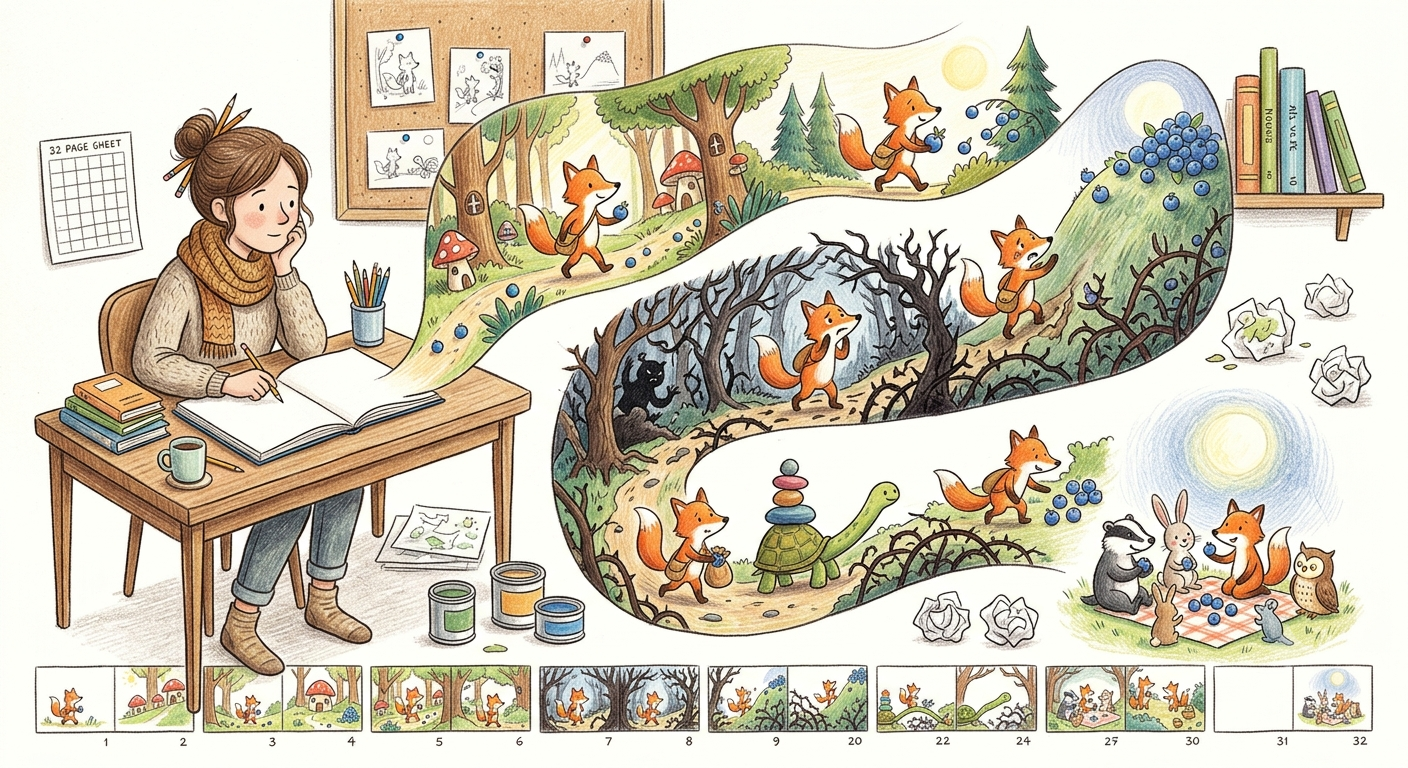
You've got a story your kid loves at bedtime, and you want to turn it into a real book. Then you open a blank page and freeze. To write a children's picture book, you build a simple shape (a setup, a turn, a resolution) across about 32 pages, write each page as one or two lines meant to be read out loud, and let the page turn do the suspense. That's the whole craft in one breath. The rest of this is how to do each part well.
A picture book is not a short story with pictures bolted on. It's a thing a grown-up reads to a small person, out loud, probably for the fortieth time, while that small person watches the pictures and waits to turn the page. Write for that moment and you can't go far wrong.
What's the basic structure of a picture book?
Three beats. A setup that introduces your character and what they want, a turn where something goes wrong or changes, and a resolution that pays it off. Most picture books that work fit this shape, even the weird ones.
Take The Gruffalo. A small mouse walks through a wood (setup). He invents a monster to scare off predators, then the monster turns out to be real (turn). He outwits it by pretending to be the scariest thing in the wood (resolution). Setup, turn, payoff. Simple shape, enormous charm.
You don't need subplots. You don't need a cast of twelve. One character, one want, one problem, one satisfying end. The constraint is the gift here.
Why are picture books usually 32 pages?
Printing, mostly. Books get printed on large sheets folded into groups of pages, and those groups come in multiples of eight. Thirty-two pages folds cleanly and keeps printing costs sane. Once you subtract the title page and the front matter, you're left with roughly 28 to 30 pages of actual story.
What that means for you: you're not writing freely until you run out of ideas. You're writing into a frame. Think in spreads (the two pages a reader sees at once) and you'll have around 14 of them to tell the whole thing. That frame is a planning tool, not a cage.
How do I pace a story across the pages?
One beat per page. That's the rule worth tattooing somewhere. Each page (or spread) should land a single moment, then hand off to the next.
The page turn is your best tool, and most first drafts waste it. The turn is a tiny cliff-hanger. End a page on a question and the child has to flip to find out. She opened the door, and behind it was… Turn. The reveal lives on the next spread. Read a few favourites out loud and watch where the suspense sits. It's almost always right before a turn.
A worked mini-example. Say your hero is a fox named Pickle who's afraid of the dark.
- Spread 1: Pickle won't go to bed. The dark is too big.
- Spread 2: His mum gives him a tiny lantern. He's not convinced.
- Spread 3: A noise outside. He has to go look. (Turn the page to find out.)
- Spread 4: It's just a hedgehog, also scared of the dark.
- Spread 5: They sit together. The dark feels smaller with company.
Five spreads, one beat each, a turn doing the heavy lifting in the middle. You'd stretch it to fill your page count, but the spine is already there.
How few words can I get away with?
The art carries half the story, so your words should never describe what the picture already shows. If the illustration shows Pickle clutching his lantern in a dark room, you don't write "Pickle held his lantern in the dark room." You write something the picture can't say: It wasn't so bad, the dark, if you had a light of your own.
Word economy isn't about being clever or sparse for its own sake. It's about leaving room for the picture to do its job, and leaving room for the child to look. Most picture book text is well under 1,000 words. Plenty of brilliant ones are under 500.
How do I write words that read aloud well?
Read every line out loud. Not in your head. Out loud, in the voice you'd use at bedtime. If you stumble, the reader will too, and they'll be doing it on no sleep.
Listen for rhythm and breath. Short sentences land. A long one builds, then a short one snaps it shut. You don't have to rhyme (rhyme is hard to do well and worse to do badly), but you do have to sound good. The sound is the point.
Where does Storybench fit in?
Once your words exist, you need pictures, and that's usually where the dream stalls. You can't draw, or hiring an illustrator costs more than the project's worth, or you tried an AI image tool and your hero looked like a different child on every page.
Storybench is built around the same Book, Chapter, Page shape you just learned. You write each page as the line or two you'd read aloud, build your cast (Pickle, his mum, the bedroom) once, and every page illustrates with that same cast filled in automatically. You never type a style word, and Pickle stays Pickle from the first spread to the last. The writing is still yours. We just handle the part where you can't hold a pencil.
Now someone's going to say the words are the hard part and the pictures are the easy bit a machine can fake. Backwards. The words are the part only you can write, and they're what we want you focused on. The illustration is the part that used to block ordinary people from ever finishing. We took that block away.
Common questions
How long should a children's picture book be?
Around 32 pages is the standard, which leaves roughly 28 to 30 pages of story across about 14 spreads. Word count is usually well under 1,000 and often under 500. Shorter and tighter beats longer and baggy almost every time.
Do I need to be able to draw to write a picture book?
No. Writing the book and illustrating it are two different jobs. You can write the whole thing as read-aloud captions and handle the pictures separately, with an illustrator or with a tool that illustrates from your page text and keeps your characters consistent.
What's a spread, and why does it matter?
A spread is the two facing pages a reader sees at once. You plan in spreads because that's the unit the reader actually experiences, and because the page turn between spreads is where you hide your suspense.
Should my picture book rhyme?
Only if you can do it well. Forced rhyme is painful to read aloud and bends your story into shapes it doesn't want. Rhythm matters more than rhyme. If the prose sounds good out loud, you're fine.
Start with the words
Write the bedtime version first. The one you already tell from memory. Get the shape right, read it aloud until it sounds like you, and worry about pictures after. When you're ready to see it illustrated, with your character looking like herself on every single page, come try it. No pressure, no drawing skills, just your story finally looking like a book.
The first book we ever made took three tries to get the pacing right. Yours might too. That's allowed.