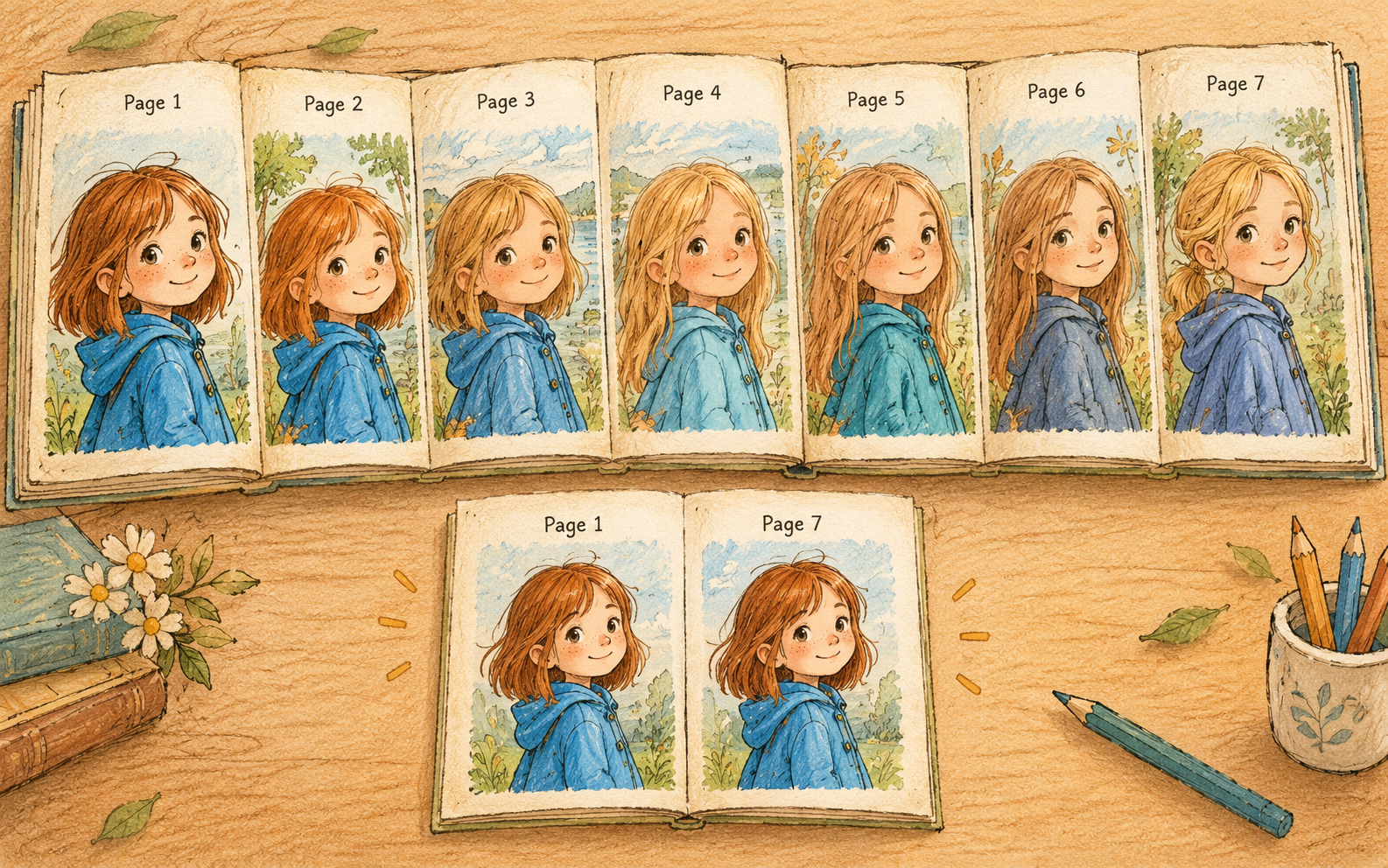
You know the feeling. Page one of your AI picture book is perfect, exactly the kid you pictured. Page seven? A stranger wearing her clothes. The "page seven" problem is when an AI-illustrated character drifts so far across a book that they stop being the same character, and it happens because each page is generated on its own with no memory of the last. The fix is a character the tool reuses instead of re-rolls.
Look at what actually changes
The drift is sneaky because it's gradual. Nobody flips from page one to page seven side by side until something feels off, and by then you've got a book that reads like a relay race between artists. Here's what tends to wander first:
- The hair. Length, color, the way it falls. Copper on page one, strawberry blond by page seven.
- The face. Eye spacing, nose, the shape of the chin. Small shifts, but a kid's eye catches them instantly.
- The palette. The blue raincoat warms up or cools down a few degrees per page until it's a different blue.
- Age. Your six-year-old quietly ages up to nine and back down to four, page to page.
Annotate a real before-and-after and you can circle every one of these. It's not subtle once you see it.
Why it matters more than you think
Here's the part adults underrate: kids notice, and it breaks the story for them.
A four-year-old who can't read yet is reading the pictures. The character is their anchor through the whole book. When the anchor keeps morphing, the spell breaks. "Wait, is that still Penny?" And once they're asking that, they've stopped living inside the story and started spotting the seams. That's the opposite of what you made the book for.
Now someone's going to say it's just a kids' book, the art doesn't have to be perfect. Agreed, it doesn't have to be perfect. It has to be the same kid. Those are different bars, and only one of them is non-negotiable.
The "after" column
So what does the fixed version look like? Page one and page seven, same face, same hair, same blue, same age. Boring, in the best possible way. The character just is herself the whole way through, and the kid never gets yanked out of the story to wonder why she changed.
You get that "after" column when the character persists instead of being regenerated each page. Build her once as part of a cast, and every page reaches for the same her. That's the entire approach behind Storybench: you author and direct, the cast stays locked, and page seven looks like page one because it's pulling from the same source, not a fresh roll of the dice. The deeper how-to is in keeping a character consistent across a whole book.
Common questions
Why does my AI character look different by page seven?
Because each page is illustrated independently, with no memory of earlier pages. Small random differences pile up page after page until, by page seven, the character has drifted into a different-looking kid.
Do children actually notice character drift?
Yes. Pre-readers follow the pictures, and the main character is their anchor. When the character keeps changing, it pulls them out of the story to wonder if it's even the same character.
How do I keep the character the same on every page?
Use a persistent character the tool reuses, rather than re-describing it each page. When the same character is inherited on every page, page seven matches page one by design.
Flip your own book from page one to page seven right now. If it's the same kid, you're golden. If it isn't, you don't have a prompt problem, you have a memory problem, and that's exactly what a persistent cast fixes. See how it works or get started.