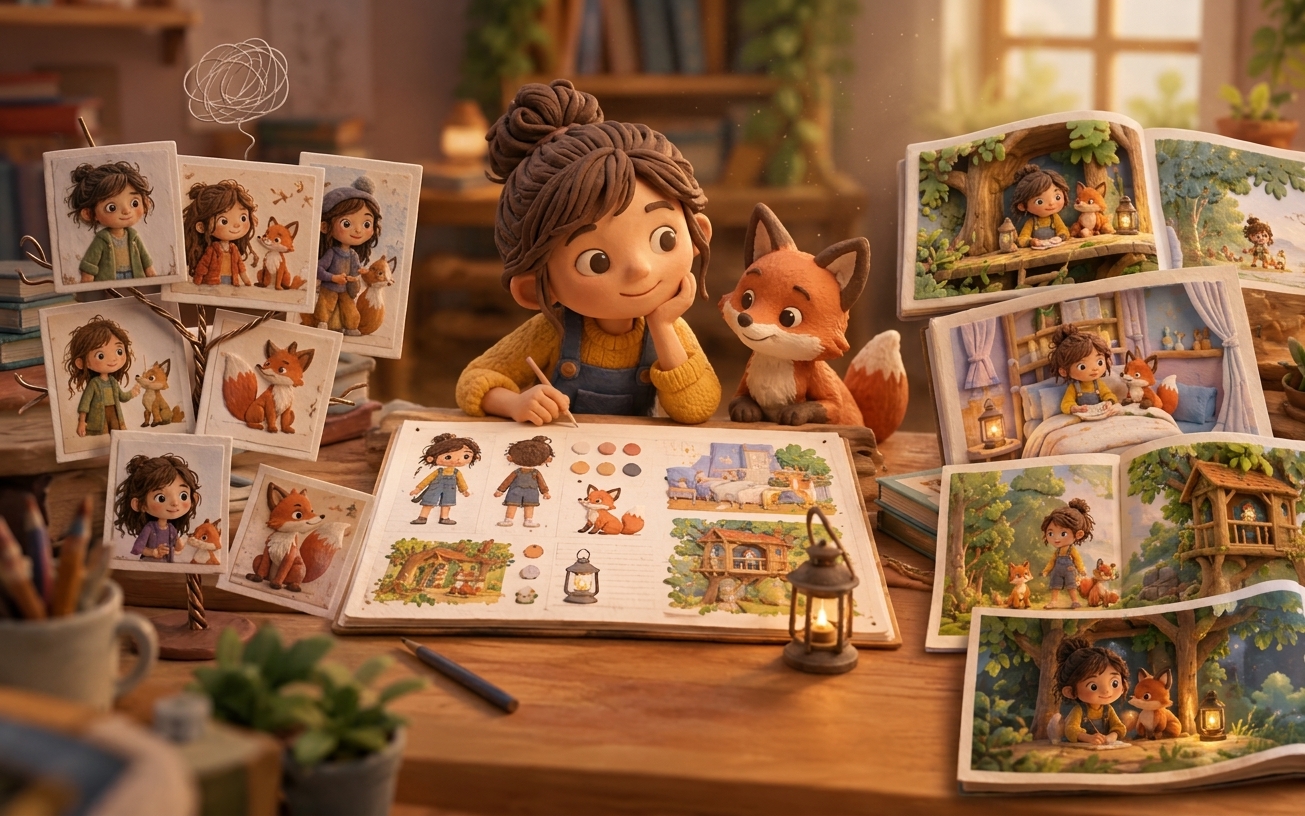
You've heard authors talk about their "story bible" and wondered if you needed one. In book-making, a cast is the set of characters, settings, and props your book reuses on every page, and a World is the place that holds them. Build the cast once, and every page pulls from it instead of starting from scratch. That's the whole idea, and it's the difference between a book that looks like one artist made it and one that looks like a committee did.
So what exactly is a cast?
Your cast is everyone and everything that shows up more than once. Three kinds of thing live in it:
- Characters: the people and creatures. Your hero, her best friend, the grumpy cat. Their look, their colors, the things that make them themselves.
- Settings: the places. The treehouse, the kitchen, the wood at the edge of town. The same room should look like the same room on page 3 and page 19.
- Props: the objects that matter. A red umbrella, a chipped teacup, a lantern. Small things readers notice when they vanish or change shape.
Take a girl named Maya and her fox, Pickle. Maya, Pickle, Maya's bedroom, and Pickle's tiny lantern are the cast. Every page that features any of them should show the same them. Not a similar fox. The fox.
What's a World, then?
The World is where your cast lives. Think of it as a story bible that the tool actually enforces, instead of a document you keep next to your keyboard and forget to follow.
A traditional story bible is a reference: notes on what your characters look like, a swatch of their colors, a sketch you hope your illustrator honors. It's only as good as everyone's discipline in checking it. A World is different. It's not a note about the cast. It's the cast itself, plugged into every page so the characters can't drift even if you wanted them to.
Why build the cast once instead of per page?
Because building once and reusing everywhere is the only way characters stay consistent across a whole book. Describe your character fresh on every page and you're rolling the dice every time. Hair color shifts. The face changes. By page seven your hero is a stranger, and a four-year-old will absolutely notice.
Reuse flips that. Build Maya once, and page after page inherits her. You're not re-describing her at the top of every page. You're not typing a single style word. You write what happens ("Maya climbs into the treehouse") and the cast fills in who Maya is and what the treehouse looks like.
The payoff compounds. Your second book reuses the world you already built, so it starts faster than your first. That's the part nobody tells you: the work you do once keeps paying you back.
Isn't this just AI doing the work?
Now someone's going to say a persistent cast means the machine writes your book. It doesn't. You decide who's in the cast, what they look like, how they're drawn, and what happens on every page. The cast just remembers your decisions so you don't have to repeat yourself fourteen times. You're the director. It's a very good memory.
This is exactly how Storybench is built. You assemble your characters, settings, and props once in the World, then write your pages. Every page illustrates with your cast already in place, in one consistent style you chose. It's the object model and the whole reason the thing exists.
Common questions
Is a cast the same as a story bible?
Close, but stricter. A story bible is a reference document you're trusted to follow. A cast (held in a World) is the reference plugged directly into every page, so it's applied automatically rather than remembered manually.
Do settings and props really need to be in the cast?
If they recur, yes. A bedroom that changes layout between pages, or an umbrella that switches color, breaks the world just as much as a character who changes faces. Anything readers see twice should be a cast member.
How big should my cast be?
As small as your story allows. One hero, a couple of supporting characters, the handful of places and objects that matter. A tight cast is easier to keep consistent and usually makes a better book anyway.
Can I reuse a cast in a sequel?
That's the best part. The cast you build for book one carries into book two, so recurring characters stay identical across the whole run. Build once, write many.
A character that drifts is a solved problem, and the solution is older than AI: you reuse, you don't re-describe. For the deep how-to, read keep an AI character consistent across a whole book. And when you want to build your own cast and watch it hold across every page, get started. Build it once. The rest gets easy.