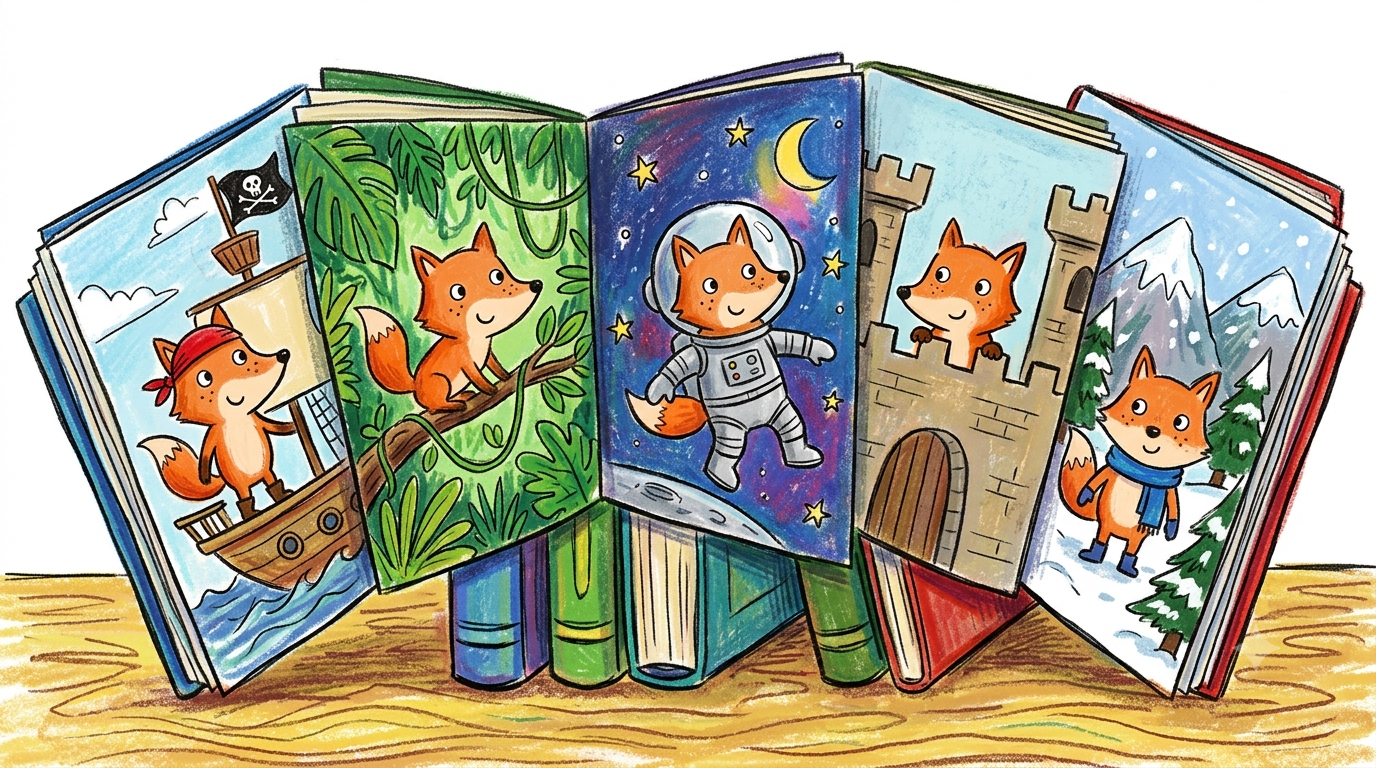
Your kid has a favorite. Not a favorite book, a favorite character, and they'll sit through any story that has them in it. That's the thing every picture-book author is quietly chasing, and it's buildable. To create a recurring character readers come back for, you give them a look you can spot in silhouette, one clear want that drives their stories, and an identity that stays exactly the same from book to book. The last part is where most people lose it.
Let's take it in order, because each piece does a different job.
What actually makes a character recurring?
Not the plot. Kids forget plots. They remember the who.
Think about why a child asks for the same character again and again. It isn't because book two had a clever structure. It's because they know that character the way they know a friend: what she looks like, how she'll react, the thing she always does. A recurring character is a small, reliable relationship. Your job as the author is to make that relationship easy to recognize and impossible to mistake for anyone else.
Three things carry almost all of that weight: a distinct look, a clear personality, and unbroken consistency. Get those, and the stories can be simple. Miss them, and no amount of plot saves you.
How do you design a look you can spot in silhouette?
The test for a great character design is the silhouette test: black it out, and you can still name them. The Gruffalo's knobbly knees and horns. Bluey's ears. Pippi's stiff braids. You don't need the color or the face, the shape already tells you who it is.
So design for the outline, not the detail. Give your character one or two strong shape choices and a couple of signature props or marks that travel with them everywhere.
- One memorable silhouette feature: oversized ears, a particular hat, a tail that curls a certain way, hair that does its own thing.
- A signature object or color: the red boots, the patched satchel, the one yellow scarf. It reads as identity in a single glance.
- An expression range you can picture: how do they look delighted, worried, fast asleep? If you can see all three in your head, so can a reader.
You don't have to draw any of this yourself. You just have to decide it, clearly enough that it stays the same every time the character shows up.
Why does personality matter as much as the look?
A look gets a kid's attention. A personality is what brings them back.
The strongest recurring characters want one simple, kid-sized thing, and they want it in every story. Bluey wants to play, and turns the whole world into a game. Elephant wants to worry about everything; Piggie wants to be delighted by everything. That single clear drive is what lets you write the second book, and the fifth, without the character feeling stretched. The situations change. The character doesn't.
Write your character's want as one sentence before you write a single page. "Pickle the fox wants to be brave but is scared of the dark." Now every story is just a new room you put that sentence in.
Why is consistency the part everyone underestimates?
A recurring character only works if it stays the same everywhere, and that is exactly where most tools fall apart.
Here's the trap. You design a gorgeous fox on page one. By page seven she's a slightly different fox: longer snout, lighter fur, the scarf is suddenly orange. By book two she's a stranger wearing your character's name. Kids notice this faster than adults do, and it quietly breaks the spell, because the relationship they had with that exact fox doesn't transfer to a fox who keeps changing.
Most AI image tools cause this by design. Each picture is generated on its own, with no memory of the last one, so every page is a fresh roll of the dice. You can fight it with longer and longer descriptions, and you'll get closer, but you're still gambling on every single page. Across a whole book that's a lot of dice. Across a series it's hopeless.
The structural fix is to stop re-describing the character and start reusing one. Build the character once, lock her look, and have every page pull from that one definition instead of inventing a new fox each time.
How do you build a recurring character once and reuse it?
This is exactly what we built Storybench to do. You define your character one time as part of your cast, her look, her colors, her signature props, and from then on every page inherits her automatically. You write what happens ("Pickle creeps down the dark hallway, ears flat") and the same Pickle shows up, in the style you already chose, without you typing a single style word.
The character lives in your World, and a World locks its illustration style when you create it. So it isn't just the character that holds steady, it's the whole look. The same Pickle, in the same art style, on page one of book one and page thirty of book four. You can re-illustrate any page until the pose is right, and she stays herself the whole time.
Now the obvious objection: doesn't that make the AI the author? No. You design the character, you write every line, you direct every scene. The tool's only job is to draw the character you defined, the same way, every time. You author. It illustrates. That division is the whole point, and it's how a recurring character becomes possible to actually maintain. (Our first one took us a couple of tries to get the want right. The look held from page one.)
See how it works if you want the mechanics, or what we built for creators for the bigger picture.
Why does this pay off more with every book?
Because the expensive part of a series is inventing and re-establishing the character. Do that once, reuse it forever, and the cost curve bends in your favor.
Your first book is where you do the building: design Pickle, set her want, lock the style. Your second book skips all of it. The cast is already there; you just tell a new story with the character readers already love. The work shifts from setup to storytelling, which is the fun part.
That's the quiet engine behind every beloved kids' franchise: one character, designed to be reused, showing up book after book without ever drifting. You can build yours the same way.
Frequently asked questions
What makes a children's book character memorable?
A silhouette you can recognize without color or detail, one clear personality drive (a single thing the character always wants), and a look that stays identical across every page and every book. Kids bond with the reliability, so consistency matters as much as the original design.
How do I keep a recurring character consistent across multiple books?
Don't re-describe the character for each book. Build it once and reuse that one definition. In Storybench you create the character as part of your cast inside a World; every new book in that World inherits the same character and the same locked art style automatically, so it can't drift.
Do I need to draw to create a recurring character?
No. You decide the look, the props, and the personality; the illustration is handled for you. No drawing or illustration skills required. You stay the author and director, the AI just draws the character you defined, the same way every time.
How many books does it take to build a series?
A series can start with two. One strong recurring character is enough to grow into a series readers follow; the trick is keeping that character identical from title to title, so the second book feels like a reunion, not a reintroduction.
When you're ready to build a character your readers will ask for by name, start your book and make the first book the only hard one.