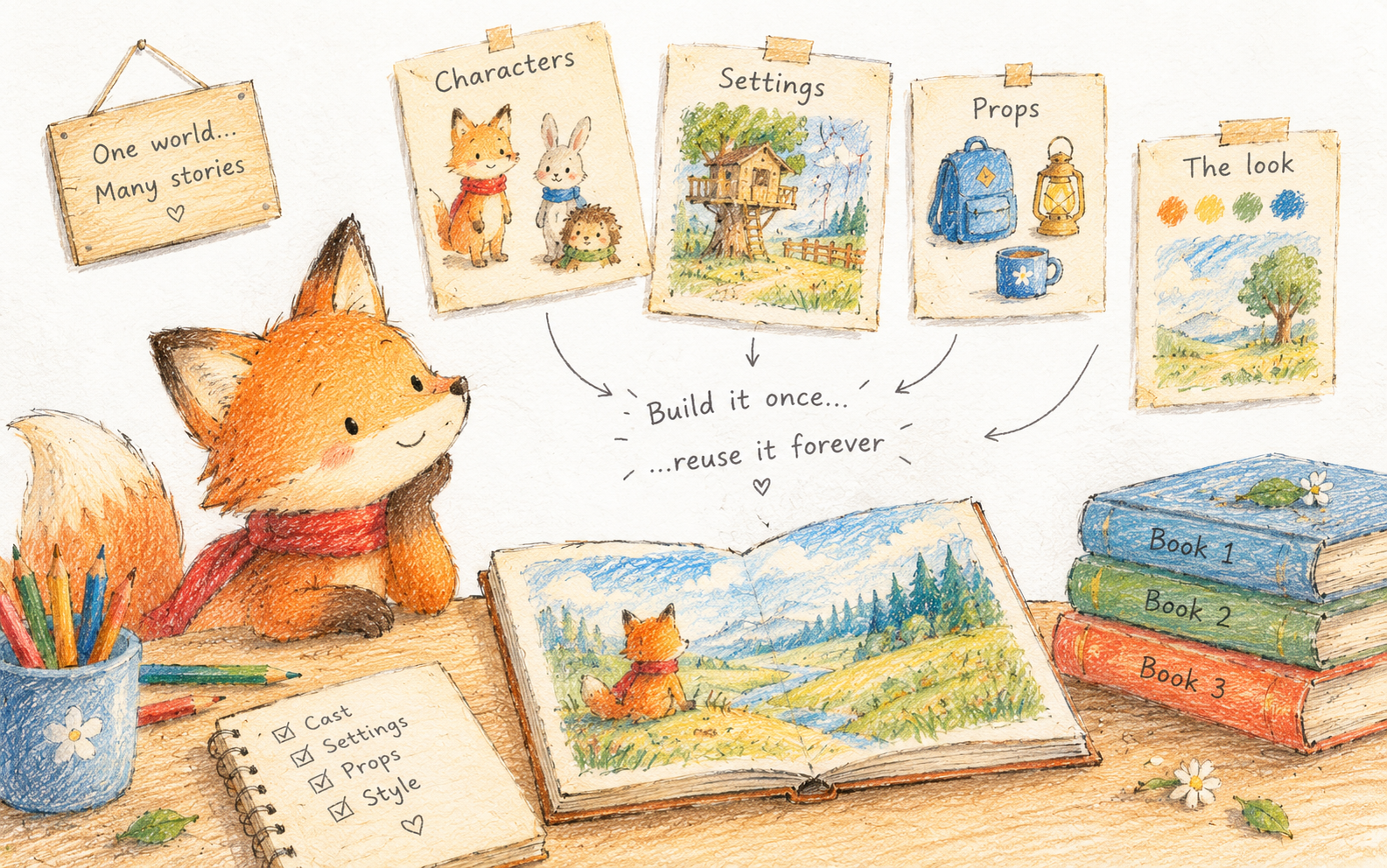
Why does the second book in a series feel just as hard to start as the first? Usually because you tear the world down and rebuild it every time. Build your story world once, characters, settings, props, the look, and every future book reuses it instead of reinventing it.
That's the whole idea here. The expensive part of a book isn't the story. It's inventing the world the story lives in. Once that world exists and holds still, the next book is mostly storytelling.
What actually goes in a story world?
A story world is the cast of things your book leans on, page after page. Not the plot. The furniture of the plot. Four pieces:
- Cast: the characters, what they look like, how they carry themselves. The fox your daughter named Pickle, with the crooked left ear and the red scarf.
- Settings: the places the story returns to. The treehouse, the meadow, the kitchen at night.
- Props: the small recurring objects. A lantern, a backpack, a chipped blue mug that shows up in every book.
- The look: one illustration style and tone that holds across everything, so the whole world reads as one place.
Plots come and go. This stuff stays. And it's the stuff you really don't want to re-describe from scratch on book two.
Why is the setup the real cost?
Think about where the hours go on a first book. Not the sentences. You write the read-aloud lines in an afternoon. The slog is getting Pickle to look like Pickle on every single page, nailing the meadow, choosing the style and holding it. Establishing the world.
Here's the trap most people fall into. They do all that establishing work inside one book, so it evaporates when the book ends. Start book two and you're back to square one: who is this fox again, what colour is the scarf, what does the meadow look like at dusk?
Now someone's going to say, can't I just keep my old files and reference them? Sure. But a folder of notes isn't a world the tool enforces. You still re-describe everything by hand, every page, every book, and the look still drifts.
How does reuse change the work?
When the world is a thing you built once and the tool holds onto, the math flips. The next book inherits the cast, the settings, the props, and the style automatically. You're not rebuilding. You're just telling the next story in a place that already exists.
This is exactly how Storybench is built. Your World is the container that holds your cast, settings, props, and one locked illustration style. You build it once in the World. Every new book inside that World starts already populated. You never re-describe Pickle, never re-pick the style, never type a style word.
And because a World locks its style when you create it, consistency is the easy case, not the thing you fight. Same fox, same meadow, same look, book after book. That's the payoff: your second book is faster than your first, because the costly part is already done.
A simple way to build yours
- Name the world and pick one style that fits the whole thing, not just book one.
- Build your cast: the hero, and anyone who'll come back. Lock their look once.
- Add the settings and props your stories will keep returning to.
- Write book one. Then write book two into the same world, and feel how much you skip.
You can see the shape of it in how it works, and the creator side of it in what you actually build.
Common questions
What's the difference between a story world and a story bible?
A story bible is a document you keep beside you and consult. A story world, the way we mean it, is something the tool actually reuses for you: the cast and style aren't notes to re-type, they're applied to every page automatically.
Can I add to my world later?
Yes. A new character, a new setting, a new prop can join the cast and then carry forward into every book after. The style stays locked so the world keeps reading as one place.
Does every book in the world have to look the same?
Within one World, yes, and that's the point. One locked style is what makes a series feel like a series. If you want a genuinely different look, that's a different World.
Do I need to be able to draw?
No. You author and direct; the illustration is handled for you. Building the world is choosing and describing, not drawing.
The first world you build is the one that keeps paying you back. When you're ready to build yours once and reuse it forever, come try it.