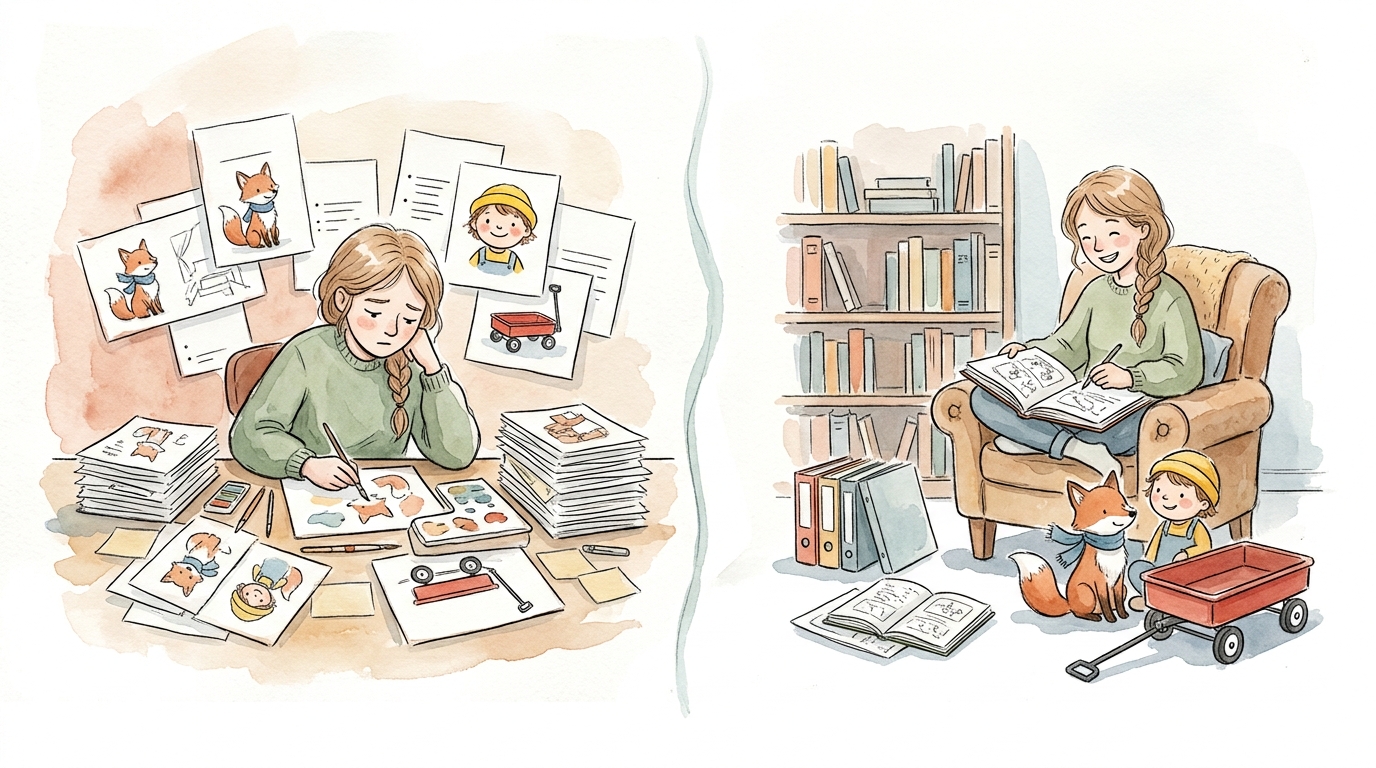
Did your first picture book take ages, and you're dreading doing it all again? Here's the good news nobody tells you: your second book is faster than your first, because the slow part was never the story. It was building the cast and world, and you only build those once.
The first book pays the setup tax for every book after it. Once that's paid, the work shifts from setup to storytelling, which is the part you actually wanted to do.
Where does the first book's time really go?
Be honest about your first book. The words came quick. A page is a line or two. You probably wrote the whole text in an afternoon and tinkered with it over a week.
So what ate the time? Establishing things. Deciding what your hero looks like and getting her to look like that on page after page. Picking a style and holding it so the book reads as one book, not twelve. Building the meadow, the bedroom, the recurring red wagon. All of that is setup, and setup is a one-time cost you keep paying if your tool forgets it.
The cruel version is when that establishing work lived inside the book and died with it. You finish, you feel great, and then book two asks: okay, who is this kid again, what color was the wagon, which style were we doing?
How does reuse front-load the cost?
Front-loading just means you pay the expensive part once, up front, and then it's done. Build the cast and the world for book one. Book two inherits all of it. Same hero, same look, same world, already there before you write a word.
So the second book skips the entire establishing phase. You open it and you're not casting, you're storytelling. New adventure, same Pickle. The fox is already the fox.
That's how Storybench works. You build your cast, settings, and props once in the World, and a World locks one illustration style. Every new book inside that World starts populated, so you never re-describe your character and never type a style word. The setup tax is paid. Book two is just the story.
The compounding feeling
There's a feeling that creeps in around book three. The world is rich now. The hero has friends, the friends have a look, the places are familiar. Each new book makes the world a little deeper, and a deeper world makes the next book easier to start, not harder.
This is the opposite of how most creative work feels, where book five is as daunting as book one. Here the runway gets shorter every time. Build once. Then keep telling stories.
Now, someone will say: doesn't a faster process mean a flatter book? No. You're spending less time fighting consistency and more time on the part that's yours, the words and the story. Faster setup buys better storytelling, not worse.
If you want the deeper version of the build-once idea, read build your story world once, or see how it works.
Common questions
Why is the second book faster than the first?
Because the first book pays for the cast, the world, and the style, and the second book reuses all of it. The setup is the slow part, and you only do it once.
Does this only help if I'm making a series?
It helps most for a series, but even two unrelated books in the same world share the look and the lead, so the second still skips the establishing slog.
Do I lose control by reusing everything?
No. You still write every word and direct every page. Reuse only removes the re-describing, not the authoring. You own the result.
What if I want a totally different style for the next book?
Then you'd start a new World, since a World locks one style. The speed payoff comes from staying in a world you've already built.
Your first book is the investment. Every one after is the return. When you're ready to start collecting, give it a try.