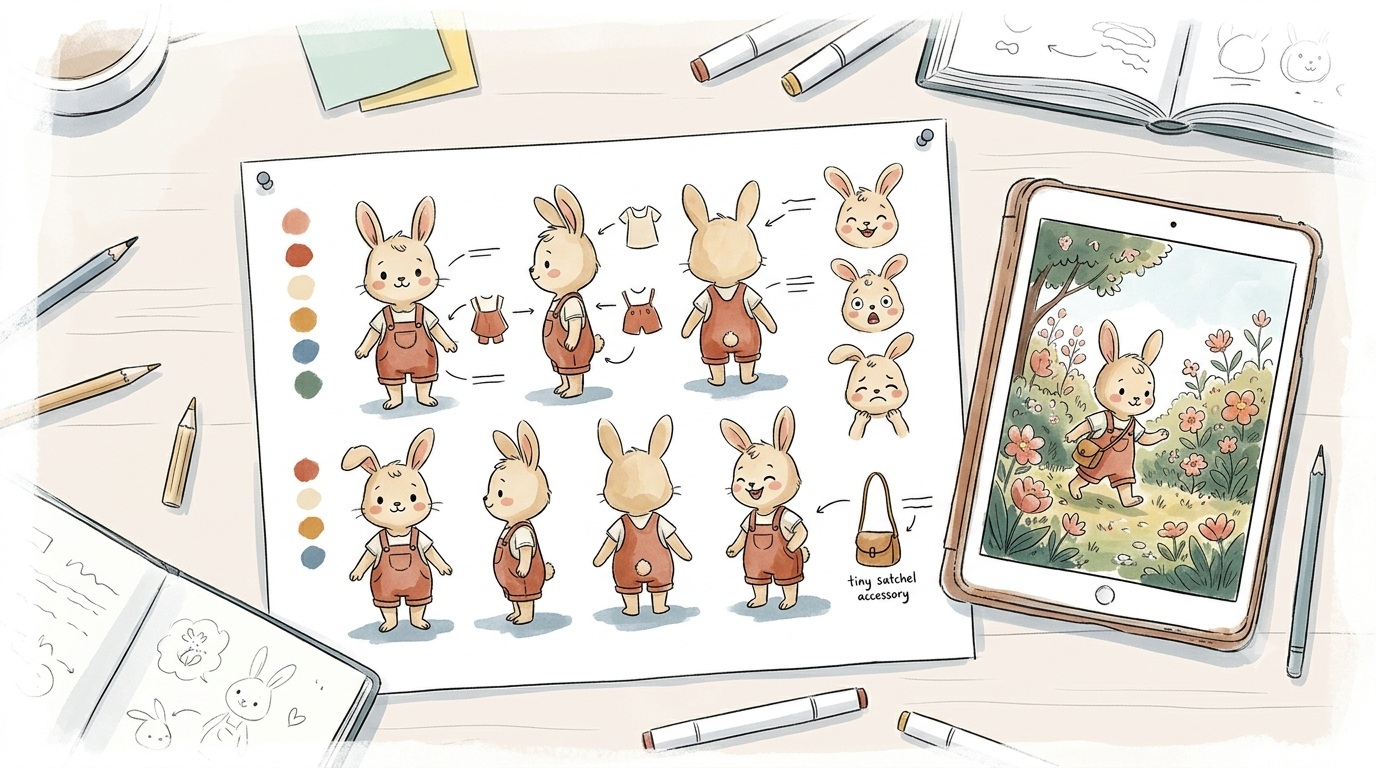
A character sheet for AI illustration is a single, settled reference for who your character is and what they look like, the face, the colors, the signature props, the range of expressions, so every illustration draws from the same source instead of inventing a new version each time. It's the thing that keeps your hero looking like your hero. And you can build one even if you've never drawn anything in your life.
What a character sheet actually is
Animators and comic studios have used these forever. They call it a model sheet: one page that nails down a character so a whole team of artists can draw them and have it still be the same character. Same proportions, same palette, same little details, no matter who's holding the pen.
For an AI-illustrated book, the idea is identical, just pointed at the tool instead of a studio. A character sheet is the difference between a character you happened to generate once and a character you can summon, on purpose, on any page.
What goes in one?
You don't need a hundred fields. You need the handful that make your character unmistakably themselves. Here's the working list:
- The core look: age, build, face shape, hair (color, length, how it sits), eyes, skin tone. The stuff a stranger would describe first.
- A locked palette: the two or three colors that are always them. Pickle the fox is rust-orange with one grey sock, every time. Wander off the palette and he stops reading as Pickle.
- Signature props or details: the yellow raincoat, the gap tooth, the perpetually untied left shoe. One or two memorable tells do more work than ten generic traits.
- A few expressions: happy, scared, mid-laugh. A character who can only do one face can't carry a story.
That's it. Notice what's missing: a backstory paragraph, their favorite food, their star sign. Lovely for you to know, useless to the illustration. The sheet is about the look.
How a sheet stops the drift
Without a sheet, every page is a fresh negotiation. The tool re-guesses your character from scratch and the look wanders, copper hair on page two, ginger on page nine. You've met this problem if you've made it past page five.
A character sheet is the anchor that ends the negotiation. Instead of re-describing the look each page (and re-rolling the dice each page), every illustration reaches back to the same settled reference. Build it once, and the freckles stop moving around.
Now someone's going to say a sheet is just extra homework before the fun part. Sort of. But it's homework you do once, and it pays off on every page after, instead of fighting the same drift over and over. Front-load it and the rest gets easy.
You don't need to draw it
Here's the part that surprises people: a character sheet doesn't have to be a hand-drawn page of poses. You can describe your character in plain words and settle the look from there, no pencil required. The output is the same, a fixed reference the illustrations reuse, you just got to it without art skills.
In Storybench, this is exactly what happens when you build a cast member. You set up your character once, the look gets locked, and from then on every page inherits it automatically. The character sheet isn't a document you babysit; it's baked into the cast, and you never re-describe the character or type a style word again. It's the same idea behind keeping a character consistent across a whole book, just from the character's-eye view.
Common questions
What is a character sheet in AI illustration?
It's a fixed reference for a character's look, the face, palette, signature props, and key expressions, that every illustration draws from, so the character stays the same across pages instead of being re-invented each time.
Do I need to be able to draw to make one?
No. You can settle a character's look from a plain-language description. The point is a consistent reference the tool reuses, not a hand-drawn page, so no drawing skills are needed.
How is a character sheet different from a detailed prompt?
A prompt is words you retype each page, and words leave gaps the tool fills randomly. A character sheet is a locked reference reused on every page, so the look holds instead of drifting.
Settle who your character is once, and you stop arguing with the dice on page seven. When you want to build one without drawing a thing, see how it works or start creating. Lock the look. Tell the story.