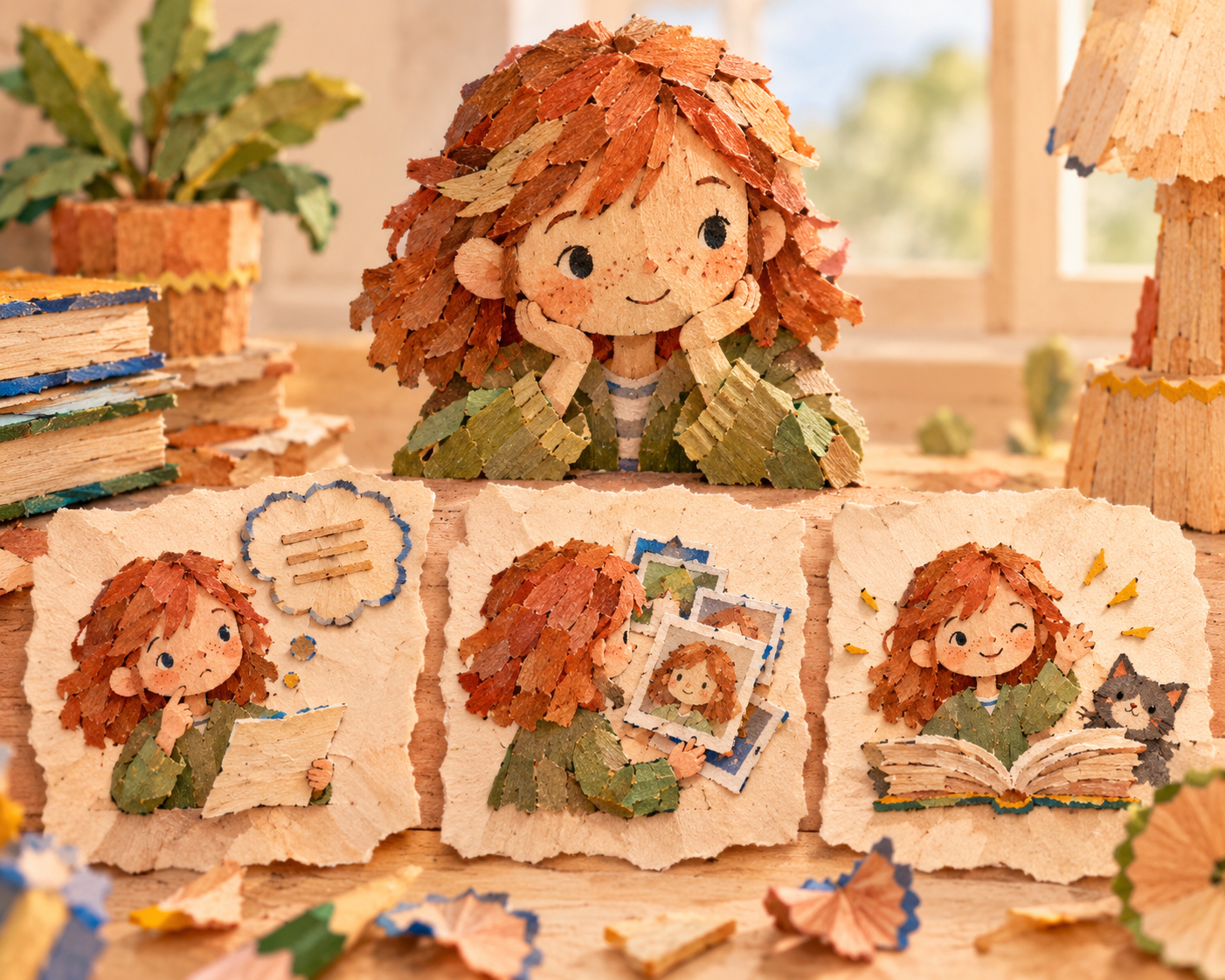
You can make AI characters consistent three ways: re-prompt the same description on every page, feed the model reference images of your character, or build a persistent cast the tool reuses for you automatically. They sound similar. They are not. Re-prompting barely holds, reference images help but take effort and still slip, and a persistent cast is the only one that reliably survives a whole book. Here's the honest comparison, including where each one falls down.
Why does this even need three methods? Because every AI image generation is independent by default. The model doesn't remember the face it drew thirty seconds ago. So "keep my character the same" is really the question "how do I give the model a memory it doesn't have." Three answers, in rising order of how well they work.
The quick comparison
Three methods, scored on the things that actually matter: how much effort each page costs you, how reliably the character holds, and whether it survives a full 32-page book.
- Re-prompting — Effort: high (you rewrite the description every page). Reliability: low. Scales to a whole book? Not really.
- Reference images — Effort: medium-high (you supply and manage refs each time). Reliability: medium. Scales to a whole book? Partly, with babysitting.
- Persistent cast — Effort: low (build once, reuse everywhere). Reliability: high. Scales to a whole book? Yes, that's the point.
🖐️ NEEDS YOU — TABLE: Verify and render the three-method comparison above as a proper table (Method × Effort / Reliability / Scales-to-a-book) before publishing.
Method 1: re-prompting the same description
The instinct everyone has first. You write a careful description ("a seven-year-old girl with curly red hair, freckles, a green raincoat") and paste it at the top of every page's prompt, praying the model draws the same kid.
It sort of works for the broad strokes. Red hair stays red. But the specifics wander. The exact curl, the face shape, the shade of green, the freckle pattern, all of it drifts page to page because words are a lossy way to pin down a face. There are a thousand red-haired girls that match your sentence, and the model picks a different one each time.
Pros: no extra files, works in any text-to-image tool, costs nothing to start.
Cons: unreliable on the details kids notice, and the effort is brutal. You're rewriting and tweaking the same paragraph 30 times. By page seven you'll have a folder of "close but not quite" rejects.
Method 2: feeding the model reference images
A real step up. You generate or supply images of your character and hand them to the model as a reference each time, so it has something to look at, not just a sentence to interpret.
This holds the face much better than words alone. The trouble is upkeep. You have to make good references first, keep track of which ones to use, and re-supply them every page. New pose, new angle, new lighting, and the resemblance can still slip because the model is interpreting your reference, not locking to it. It's babysitting. Better odds, but you're still in the loop on every single page.
Pros: noticeably more consistent than re-prompting, gives you a real anchor for the look.
Cons: manual and fiddly, you manage the reference files yourself, and consistency still degrades across many varied poses. It scales to a book only if you've got the patience of a saint.
Method 3: a persistent cast the tool reuses for you
The only method built for a whole book instead of a single image. You define your character once as a cast member (the look, the colors, the details), and from then on every page reuses that cast automatically. You don't re-describe. You don't re-supply references. You don't even type a style word.
The shift is structural. Methods 1 and 2 ask you to re-establish your character on every page. A persistent cast establishes it once and applies it to all of them. The per-page gamble disappears, because there's no per-page decision left to gamble on. Your hero on page 28 inherits the exact same cast as your hero on page 1.
Pros: genuinely consistent across a full book, low per-page effort, and the cast carries into your next book too.
Cons: honest version: you need a tool actually built around a persistent cast, not a generic image generator with a reference slot bolted on. Most aren't.
So which should you use?
For a one-off image, re-prompting is fine. For a few related pictures, reference images will get you there with effort. For an actual book, where the character has to be the same across 30 pages and ideally the sequel, a persistent cast is the one that holds up. The other two were never designed for the distance.
That's the approach Storybench is built on. You build your cast once, every page inherits it, and the character stays itself from the first page to the last. We're biased, obviously, but the honest engineering reason is simple: it's the only one of the three that removes the per-page roll of the dice instead of just improving your odds on each roll.
Common questions
Can't I just write a really detailed prompt?
You can, and it helps a little, but detail has a ceiling. No description is specific enough to single out one exact face from the infinite faces that match it. Words narrow the field; they don't lock it. That's the structural reason re-prompting drifts.
Are reference images good enough for a short book?
For a short, low-variety book with patience, maybe. The risk grows with page count and with how many different poses and angles you need. The more your character moves, the more a reference-only approach tends to slip.
What's the difference between a reference image and a persistent cast?
A reference is something you hand the model to look at each time, and you manage it. A persistent cast is your character stored as a reusable part of the project, applied to every page automatically. One is a hint you keep repeating; the other is a fact the book already knows.
Does a persistent cast work across more than one book?
Yes. The cast you build for one book can carry into the next, so recurring characters stay identical across a whole series of titles, not just within one.
If you only remember one thing: the first two methods improve your odds on each page, the third removes the bet. For the full picture, read the pillar, keep an AI character consistent across a whole book, or see how it works. And when you're ready to build a cast that just holds, get started. Try the boring, reliable one.