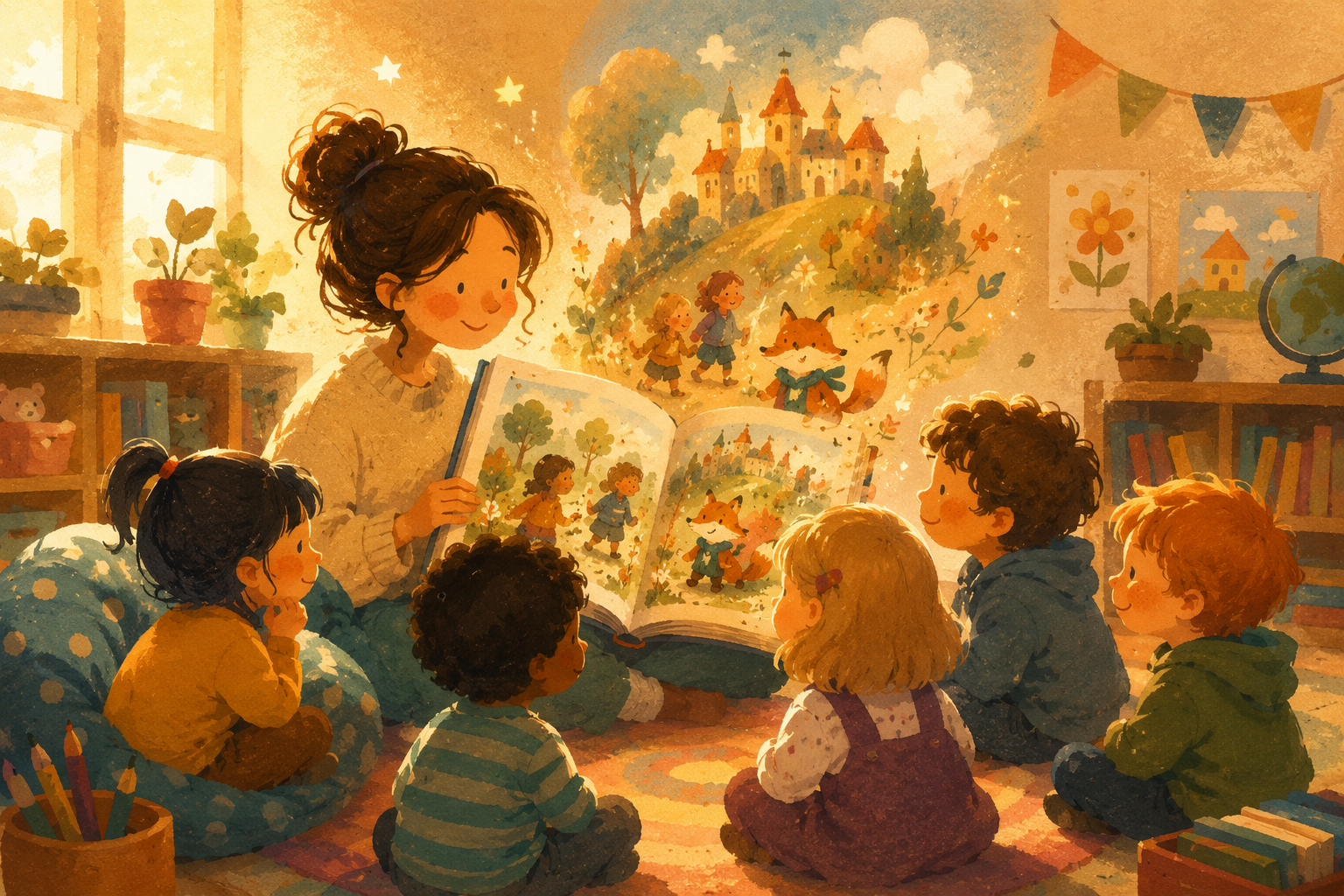
Ever watched a kid sit up because a story said their name? Personalized books for the classroom are stories built around your actual students: their names, your room, the exact lesson you're teaching this week. You write the words, you pick the faces, and the book speaks to the kids in front of you instead of some generic every-child who lives nowhere.
The catch has always been that making one meant hiring an illustrator or being one. Not anymore. You can build a custom picture book that stars your class, holds together across every page, and prints clean, without drawing a thing.
Why does personalization make a story land harder?
Because attention follows recognition. A kid who spots their own name, their teacher, the reading corner with the wobbly beanbag, leans in. They're no longer being read at. They're in it.
That pull does real work. The lesson you're trying to teach (sharing, the water cycle, what to do when you're scared on the first day) rides in on a story the child already believes is about them. Mirror stories, the kind where a kid sees themselves, are some of the most effective tools we have for social-emotional learning. A book about "a child who felt nervous" is fine. A book about Maya, who sits by the window and has a little brother named Theo, is the one Maya carries to circle time and asks for again.
Now someone's thinking: sure, but I can't draw, and I don't have a week. Fair. Let's take both.
What can you personalize?
More than just swapping a name into a template. Real personalization is specific:
- The kids themselves - your students as characters, looking like a class, not stock clip art.
- Your room - the carpet, the cubbies, the class pet, the view out your window.
- The exact lesson - the thing you're teaching this unit, told as a story instead of a worksheet.
- A class mascot - a fox, a robot, a friendly cloud that shows up in every book you make all year.
That last one is the quiet superpower, and it leads straight to the hard part most tools get wrong.
How do you keep a class mascot looking the same in every book?
Here's where most AI illustration tools fall down. They have the memory of a goldfish. Each picture is a fresh roll of the dice, so your mascot fox is orange on page one, reddish on page three, and somehow a different animal entirely by the book about subtraction. Kids notice. Consistency is the whole game, and it's the thing a slot-machine image tool can't give you.
The fix is to build your characters once and have every page reuse them. That's exactly how Storybench is built. You set up your cast (your mascot, even your students) one time, and every page you illustrate after that inherits the same look automatically. You never re-describe the fox. You never type a style word. He just shows up, the same fox, page after page, book after book.
Build the mascot once. Reuse him across every little book you make this year.
How would a teacher actually make one?
The rough shape of it, start to finish:
- Pick the lesson or the moment. One idea per book. "Rosa learns to wait her turn" is plenty.
- Write the pages in your own words, a line or two each, the way you'd read them aloud.
- Set up your cast and pick a style. You get a range of illustration styles, 2D and 3D, and you choose one for the whole book so it stays consistent.
- Illustrate page by page. Your cast fills in automatically, so the kids and the mascot stay themselves.
- Publish. Export a print-ready PDF to run off copies, an EPUB for tablets, or image files of every page to send home to families.
The words are yours. The drawing is the tool's job. That division is the point: a story about your class should sound like you, not like a model that's never met them.
Does this replace real books?
No, and it shouldn't try to. Keep your shelf of Bluey and The Gruffalo and the classics your kids already love. Personalized books for the classroom do a different job: they fill the gap where no published book exists, the lesson that's specific to your room, the kid who needs to see exactly their situation on the page this week. Think of it as a tool for the stories only you would think to tell.
Frequently asked questions
Do I need to know how to draw?
No. You write the words and direct the scene; the illustration is handled for you. No drawing or design skills are required.
Will my class mascot look the same on every page?
Yes. You build the mascot (and any recurring characters) once, and every page reuses them, so the look stays consistent across the whole book and across every book you make.
Can I print copies for my class?
Yes. You can export a print-ready PDF for print-on-demand or your own copier, an EPUB for tablets, and image files of every page to share with families. The book is yours.
Is this good for social-emotional learning?
It's a strong fit. A story written for one child's exact situation (a new sibling, first-day nerves, sharing) gives them a mirror to see themselves in, which is what makes mirror stories work for SEL.
Make the first one
You know your kids better than any publisher ever will. That knowledge is the whole asset here. When you're ready to turn it into a book your class will actually ask for, start your book and start with one small story. See how it works, or read more about what creators are building. (Our first one took us a couple of tries to get the mascot right. Yours will too. That's fine, you just re-illustrate the page.)