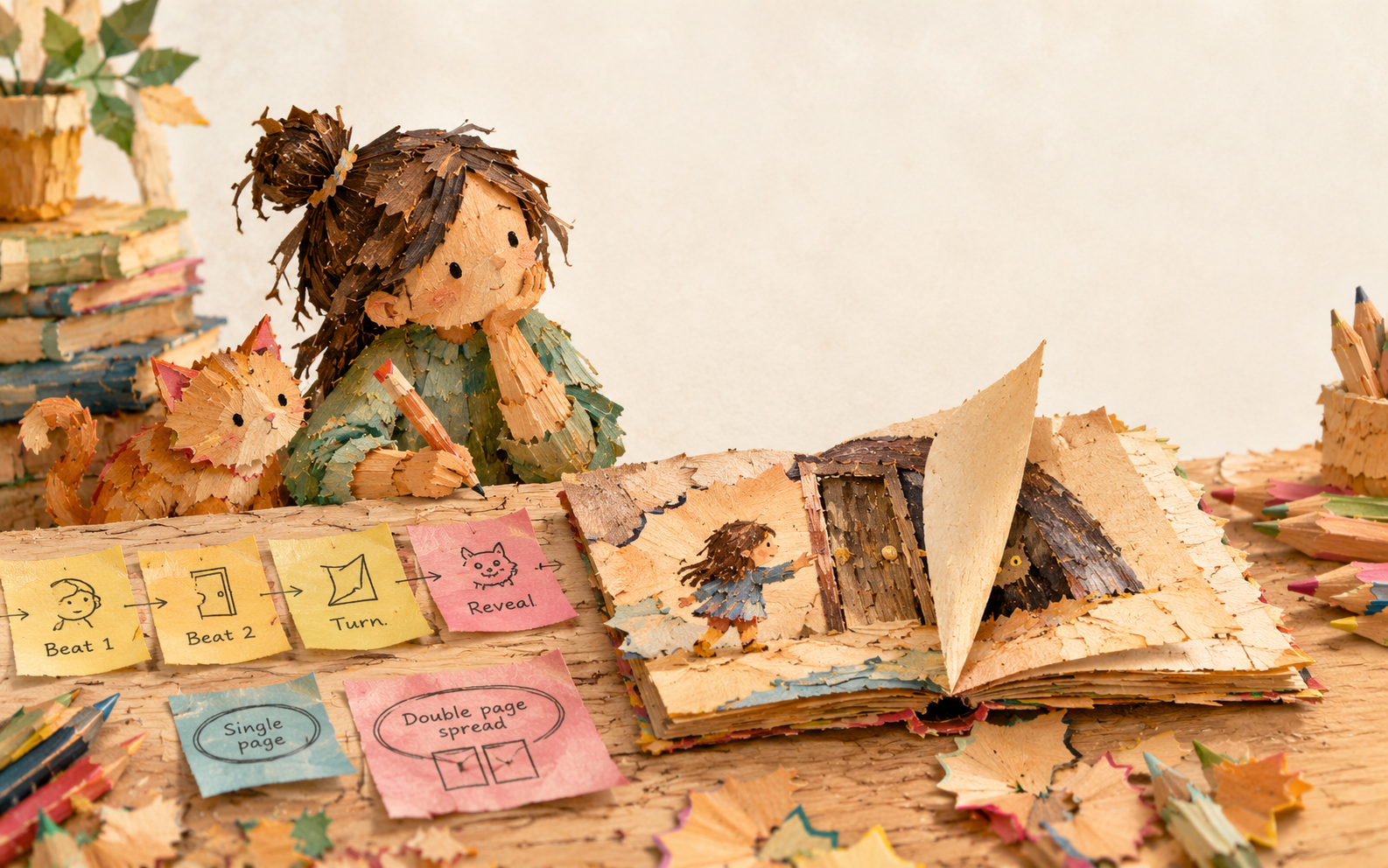
Staring at a story you love and no idea how it becomes a book? You plan a picture book page by page: you chop the story into beats, drop one beat per page, and use the page turn as a built-in cliffhanger. That's the whole trick. Do this before you illustrate a single thing and the book almost builds itself.
Skip it, and you end up cramming three events onto one page and stretching one event across five. The plan is what gives a picture book its tick-tock pacing.
Why plan the pages before you illustrate?
Because the page is the unit of a picture book, not the paragraph. A picture book isn't a wall of text with art sprinkled on. It's a sequence of moments, each one a page or a spread, and the rhythm of how those moments hand off to each other is the reading experience. Plan the handoffs first and the illustration step gets a hundred times easier, because you already know what each page needs to show.
What's a spread, and why does it matter?
When a book is open, you see two pages side by side. That's a spread, and the reader takes it in as one picture. So a big emotional moment usually wants a full spread to itself, art running edge to edge across both pages. A quick beat might only need a single page. Knowing which moments are spreads and which are singles is half of planning.
A handy fact for budgeting your space: most picture books land around 32 pages, for printing and attention-span reasons (we dug into why 32 pages separately). Once you subtract the title and copyright pages, you've got roughly a dozen or so spreads to tell your story in. That constraint is a gift. It forces you to pick the moments that matter.
How do you actually map it out?
You don't need software. A stack of sticky notes or a folded sheet of paper works. Here's the order:
- List the beats. Write your story as 10 to 14 short moments. "Pip can't sleep." "Pip hears a noise." "Pip goes to look." One line each.
- One beat per page. Give each moment its own page or spread. If a page has two things happening, it's probably two pages.
- Find the turns. Mark every spot where the reader will gasp, laugh, or worry. Those are your reveals.
- End pages on a hook. Put the question at the bottom of the page and the answer after the turn. Make them flip to find out.
- Mark your spreads. Circle the two or three biggest moments. Those get the full double-page treatment.
How do page turns build suspense?
The page turn is a curtain. Whatever you hide behind it, the reader has to do something (lift the page) to find out. That tiny act of effort is suspense, for free.
So plan your reveals to land right after a turn. End a page on "Pip pushed the door open..." and put the monster (or, better, the lost teddy) on the next spread. The kid practically rips the page over. A reveal that sits in the middle of a page just doesn't have that pop. Place it across the fold.
One beat per page. The best surprise after every turn.
Then you've got a real shape to fill
The reason this matters: once your page map exists, you're not facing a blank canvas anymore. You're facing twelve known pages, each with a job. That's a much friendlier place to write the final words and start illustrating.
A planned book is a book you can finish. It's also why Storybench gives you a real Book and Page structure to work in rather than an empty document: you drop your beats onto pages, write each page in your own words, and illustrate into a shape you already mapped. (Want the bigger craft picture first? Start with how to write a children's picture book.)
Frequently asked questions
How many pages should I plan for?
Most picture books run about 32 pages total, which leaves roughly a dozen spreads for the story itself after front and back matter. Plan your beats to fit that, give or take.
Do I need to storyboard if I'm using AI to illustrate?
Yes, and arguably more so. Knowing what each page should show is exactly what makes the illustration step clean. The plan tells you what to ask each page to do.
What if my story doesn't fill the pages?
Stretch the best moments across spreads or add a quiet beat or two. But short and tight beats padded and slack every time. Don't invent filler just to hit a number.
Map it, then make it
Grab those sticky notes and lay your story out as pages tonight. When the map feels right and you're ready to build it for real, start your book and turn your page plan into a finished book.