Here's the thing nobody tells you about describing a scene for AI illustration: the best page descriptions are shorter than you'd think, and they leave out the part beginners cram in first. You describe what's happening on the page, the action, the setting, the mood, the framing. You leave out what your character looks like, because that should already be handled.
Get that split right and the illustration comes back looking like the page you pictured. Describe the moment, not the character.
What belongs in a page description?
Four things, roughly, and they're all about this page, not your character's permanent identity:
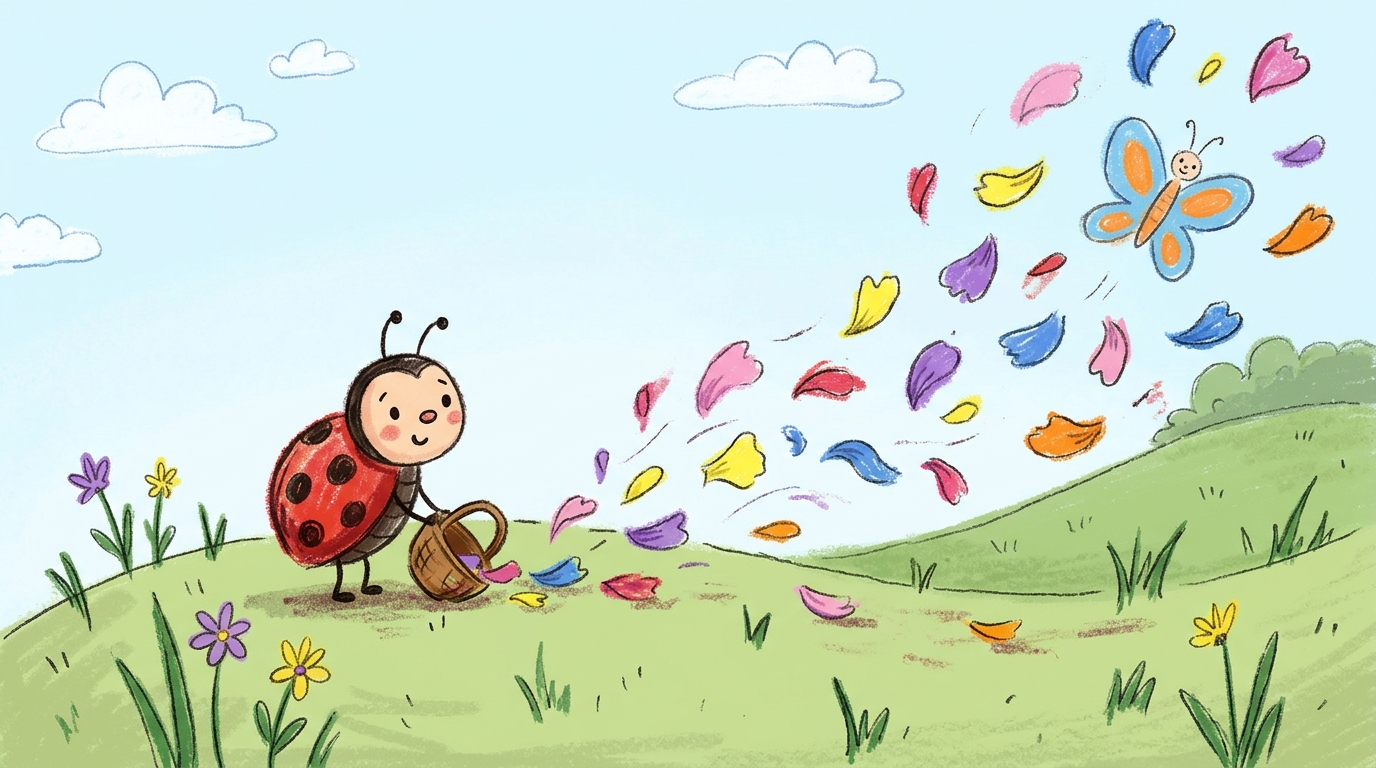
- The action. What is happening? "Bella, the ladybird, carries a tiny basket of flower petals up a grassy hill."
- The setting. Where are we? "On a grassy hillside covered with tiny wildflowers, in the late afternoon."
- The mood. How should it feel? Cheerful, peaceful, playful, or adventurous.
- The framing. Close on Bella's face, or wide so we can see the little ladybird making her way up the hill? This one beginners skip, and it's the biggest lever you've got.
Notice what's not on that list: Bella's colours, her spots, her little wings, the flowers around her, or the illustration style. We'll get to why.
What should you leave out (and why)?
Leave out everything that stays the same on every page. Your character's look. The palette. The illustration style. If you're re-typing "a small, cute ladybird with a bright red shell, tiny black spots, delicate wings, and a soft watercolour illustration style" on page after page, you're doing a job the tool should be doing, and doing it inconsistently, because you'll word it slightly differently every time and the look will wobble.
The character's identity should live in one place and get reused, not get re-described from memory each page. When it does, you're free to spend your words on what actually changes: the action and the feeling.
Weak vs. strong: a quick before and after
A weak page description tries to do everything and pictures nothing clearly:
"A cute little ladybird character with a bright red shell, tiny black spots, big expressive eyes, delicate wings, and a cheerful expression, crawling among green leaves and colourful wildflowers, soft watercolour illustration style, children's picture book."
That's all identity and adjectives, no moment. The tool has nothing specific to draw, so it guesses, and the guess drifts from your last page. Now the strong version, assuming the ladybird already exists as a saved character:
"Bella crouches at the top of a grassy hill, her tiny basket of flower petals tipping over, with petals already starting to scatter in the breeze. Wide shot so we can see the whole hillside below her. Warm golden afternoon light. She looks delighted and slightly guilty."
See the difference? The second one is a scene. It has a verb, a place, a camera, and a feeling. It doesn't waste a word on what Bella looks like, because Bella always looks like Bella.
A simple recipe to write any page
- Start with the verb. What is the character doing? Lead with the action, not the description.
- Set the place and time. One short clause is plenty.
- Pick the shot. Close-up for emotion, wide for scale or chaos. Choose on purpose.
- Name the feeling. One mood word steers the whole image.
Action, place, shot, mood. Keep it that tight and you'll be amazed how often the picture matches your head on the first try.
Where Storybench fits
This split, describe the scene, never the character, is exactly how Storybench works. You build your cast, settings, and props once in your World and pick one style. Then on each page you just write what's happening, and the character, the world, and the look fill in automatically. You never type a style word. Your page description is free to be pure storytelling.
And if the framing isn't quite right, you re-illustrate that page and try a different shot, without losing the character. See how it works. (For more on letting the picture carry its half of the story, the counterpoint between text and art is worth a read too.)
Frequently asked questions
How detailed should a page description be?
Detailed about the moment, sparse about the character. Spell out the action, setting, mood, and framing for this specific page, and leave out anything that stays the same book-wide, like the character's look and the art style.
Should I describe my character's appearance every time?
No. Re-describing the character each page is how the look drifts. Define the character once as a saved cast member and reuse it, so every page description can focus on what's happening instead.
What's the most overlooked part of a page description?
Framing. Choosing a close-up versus a wide shot changes the whole emotional read of a page, and most beginners never mention it. Decide the shot deliberately for each page.
Do I need to add style words like "watercolor" or "cartoon"?
Not in a book-first tool. The style is set once for the whole book, so you never repeat it. In Storybench you pick one style up front and every page holds it without you typing it again.
Describe the moment, trust the cast to handle the rest, and your pages start matching your imagination. When you're ready to write scenes instead of re-describing characters, give it a try.