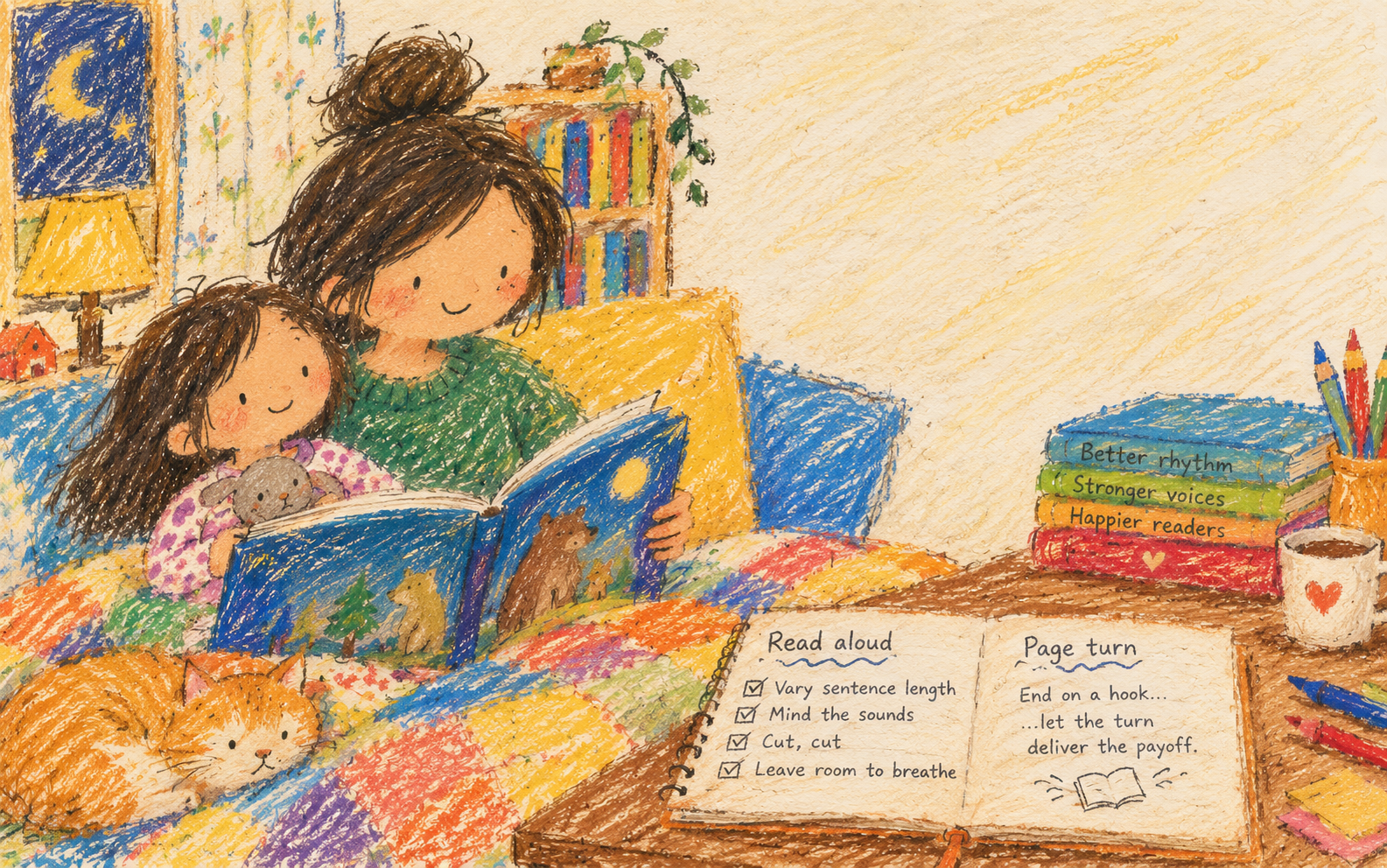
Here's a thing nobody tells you when you start: a picture book isn't really read. It's performed. A grown-up holds it at bedtime and says the words out loud, doing the voices, slowing down for the scary bit. So writing a picture book for read-aloud means writing words that sound good in a tired parent's mouth at 8pm. The page that reads fine in your head can trip the tongue out loud, and the kid will know.
The test for every line is dead simple. Read it out loud. If you stumble, the line's wrong. Fix it and read it again.
Why does read-aloud rhythm matter so much?
Because kids hear before they read. Long before a child can decode a single word, they feel the beat of a sentence, the rise and fall, the place where the voice lands. Good read-aloud text has a pulse. It's why a three-year-old will chant a book back at you, word for word, a book they cannot actually read yet. They memorized the sound of it.
Get the rhythm right and you've written something a kid will demand again tomorrow. Get it clunky and even a great picture can't save the page.
How do you write text that sounds good out loud?
A few things that actually move the needle:
- Vary your sentence length. A long, winding sentence, then a short one. The short one hits harder because the long one set it up. Like that.
- Mind the sounds. Read for the consonants. "The big brown bear" rolls; "the large dark animal" thuds. You don't need rhyme, you need mouthfeel.
- Cut a word, then cut another. Read-aloud text is lean. If the picture shows it, the words don't have to say it too.
- Leave room to breathe. A comma is a small breath. A line break is a bigger one. Punctuation is stage direction for the person reading.
What's the page turn got to do with it?
Everything. The page turn is the single best tool a picture book has, and it's invisible on a screen until you remember a child has to physically lift the corner and flip. That half-second of suspense is a beat you wrote.
So end a page on a hook and let the turn deliver the payoff. "She opened the door, and..." Turn. "...there stood the biggest dog in the world." The pause does the work. Plan your line breaks around where the page ends and you've got pacing for free. (More on mapping that out in our guide to planning a picture book page by page.)
A quick before and after
Take a flat line:
Sam was very scared because it was extremely dark in the large forest and he could not see anything at all.
Say it out loud. It runs out of air. Now break it for the voice and let the picture carry the dark:
The forest was dark. Sam couldn't see his own hands. He took one small step, then stopped.
Shorter, with stops where a reader needs to breathe. The fear is in the rhythm now, not in the word "scared." That's read-aloud writing.
This part is yours
Now the bit we actually care about. You might be tempted to let a model write these lines for you. Don't. The words a child memorizes and chants back at bedtime should be yours, in your cadence, with the little catch in the voice that's how you'd actually say it. A generated line is smooth and forgettable. Your line is the one with your kid's name tucked in, the inside joke, the way you always say goodnight.
The drawing can be the tool's job. The voice is the part only you can do. That's the whole idea behind how Storybench works: you write each page the way you'd read it aloud, and the illustration brings the scene to life around your words. You're the one reading at bedtime. Write like it.
Frequently asked questions
Does a read-aloud picture book have to rhyme?
No. Rhyme is wonderful when it's effortless and painful when it's forced. Rhythm matters far more than rhyme. A book with no rhyme but a strong beat reads beautifully aloud.
How long should each page of text be?
Usually a line or two. The illustration carries half the story, so the words can stay short. Read the page aloud; if you run out of breath, it's too long.
What's the best way to test my text?
Read it out loud, ideally to an actual child. Watch where they fidget and where they lean in. Your tongue and their attention will tell you more than any rule.
Write it the way you'd say it
Once you've got pages that sound right out loud, building the rest of the book is the easy part. When you're ready, start your book and write your first one. Read each page aloud before you move on. If it sings, keep going.