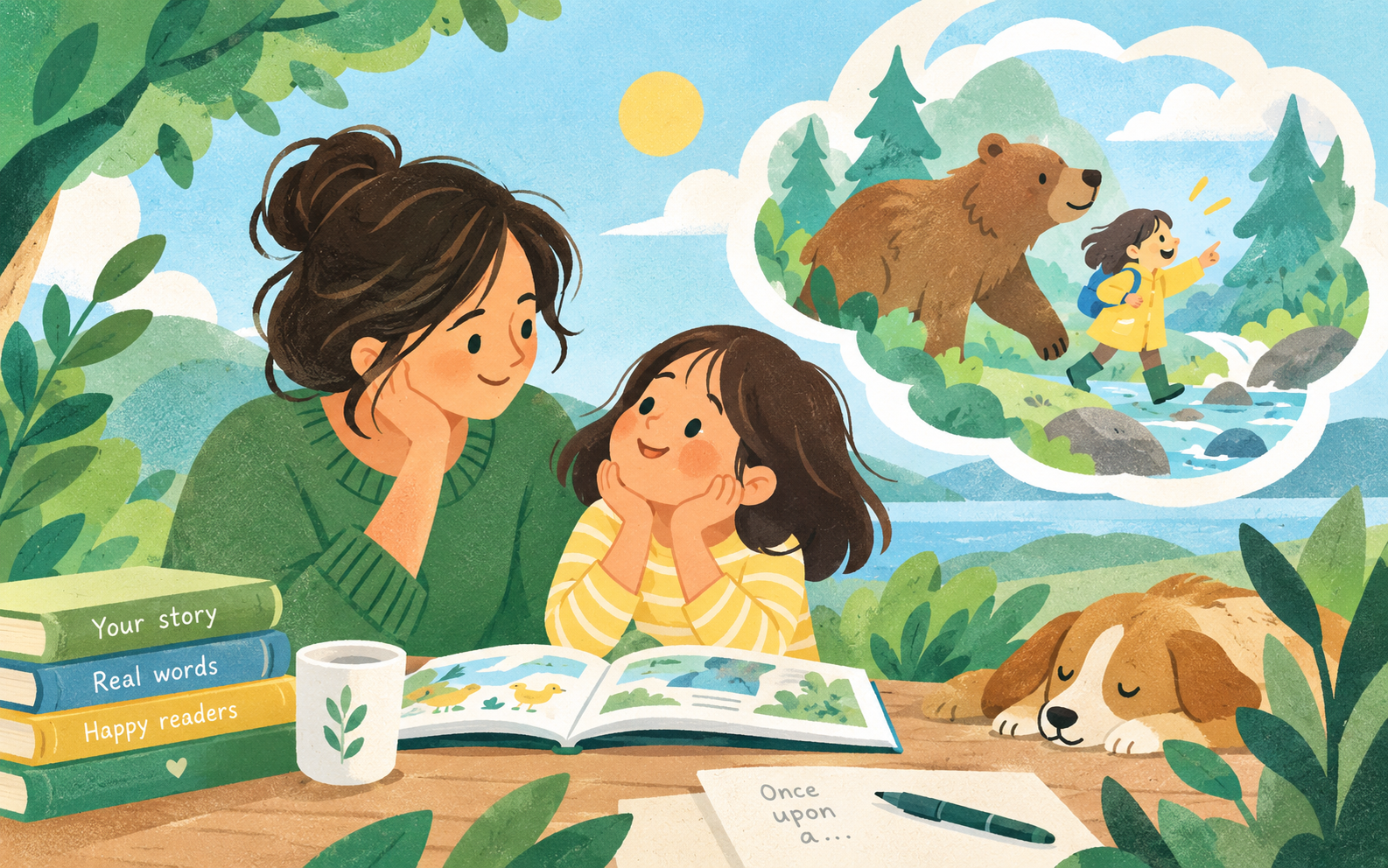
You've got a story your kid loves. You've told it out loud a hundred times. And the only thing stopping you from making it into a real book is a voice in your head saying, "but I'm not a writer." Here's the thing about how to write a children's book if you're not a writer: that voice is wrong, and picture books are the one place it's most obviously wrong.
A picture book rewards a plain, true voice over fancy prose, every time. Short sentences. Real words. The way you actually talk. That's not a consolation prize for non-writers. That's the actual craft.
Who decided you're not "a writer" anyway?
Somewhere along the way, "writer" got turned into a club with a velvet rope. Big vocabulary. Literary flourishes. A degree, maybe. None of that has anything to do with a book a four-year-old will demand again at bedtime.
Look at what kids actually love. "We're going on a bear hunt. We're going to catch a big one." Plain. Repetitive. Made of words a child already knows. The genius is in the rhythm and the truth of it, not in a thesaurus. You don't have to write well in the fancy sense. You have to write true in the read-aloud sense.
But isn't my writing just... not good enough?
This is the objection, so let's take it head on. You're picturing your sentences and wincing. Stop picturing them as text on a page and start hearing them out loud, because that's how a picture book is consumed. Read your line to the wall. Does it sound like you? Does it have a beat? Would your kid grin at it? Then it's good enough. It's better than good enough, because it's yours.
A few honest moves that do most of the work:
- Write how you'd say it. If you wouldn't say it at bedtime, don't write it down.
- Keep it short. A line or two per page is plenty. Short is not a weakness here; it's the format.
- Read it aloud. Every line. Your ear catches what your eye forgives.
- Use real detail. The specific dog, the specific blanket. Specific beats clever.
What about the part I really can't do?
Fair. You can write the words. You probably can't draw the same kid forty times without her turning into a stranger by page seven. That's the genuinely hard part, and it's the part to hand off.
That's how Storybench splits the work. You bring the words, which is the joyful, human part. The tool handles consistency and illustration: you build your cast once, every page inherits it, and you never type a style word. So the thing that was stopping you, "I can't illustrate," stops being the thing, and the part that's actually yours, the voice, is the part you keep. Know more about this here- how to write for read-aloud.
FAQ
Do I need writing experience to make a picture book?
No. Picture books reward a plain, spoken voice, which everyone has. If you can tell your kid a story out loud, you can write one.
How long does the text need to be?
Short. A line or two per page across roughly 32 pages. The art carries half the story, so the words don't have to do everything.
What if I can't draw at all?
Then you hand the drawing off. You write and direct; the illustration and the character consistency are handled for you, no art skills required.
How do I know if my writing is good enough?
Read it out loud. If it sounds like you and has a beat your kid would enjoy, it's there. Out loud is the only test that matters for this format.
You've already written this book, out loud, a hundred times. All that's left is to put your words down and let someone else handle the pictures. When you're ready, get started. Bring the voice you already use. It's the qualification.