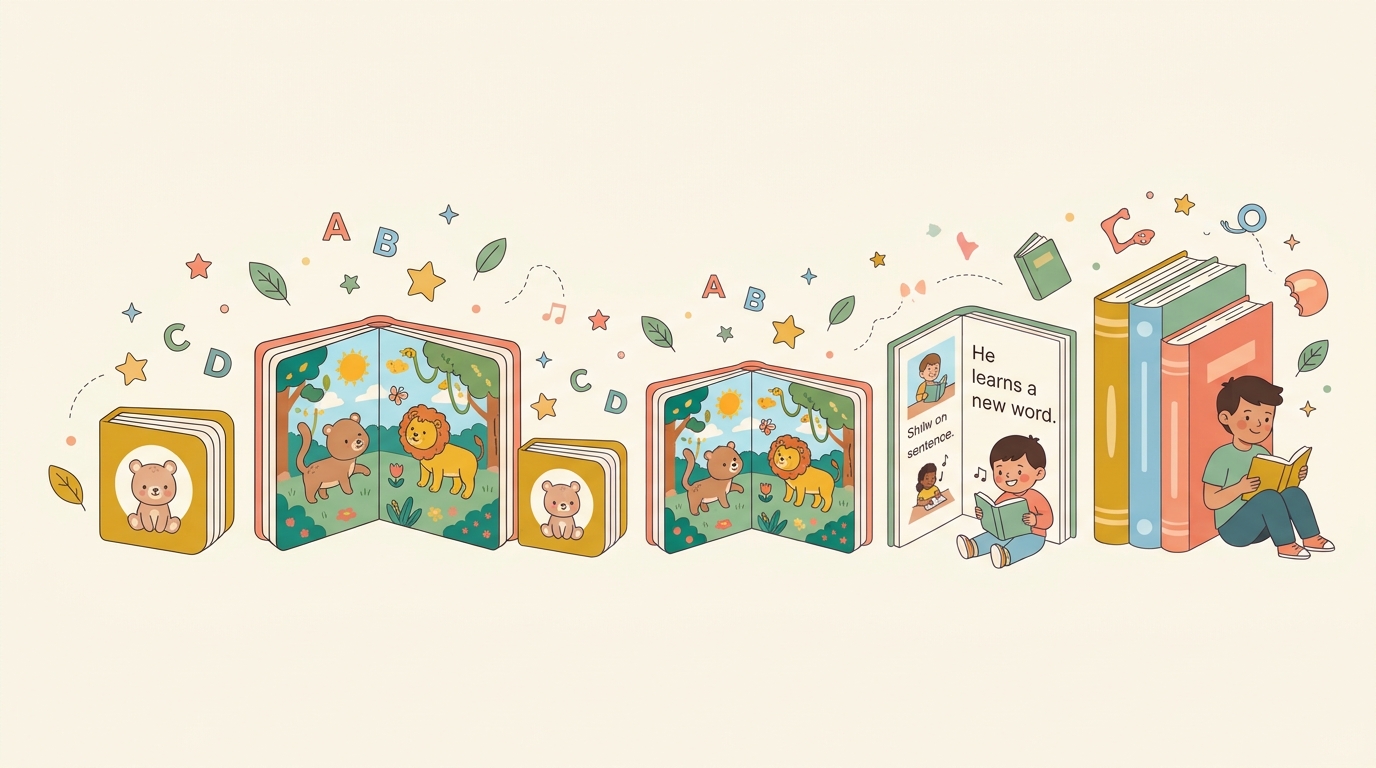
Short answer up front: children's book length climbs with reading age, and word count rises faster than page count. A board book for a baby might be a few dozen words; a picture book for a preschooler usually runs well under a thousand; an early reader is longer and simpler; a chapter book for an eight-year-old runs into the thousands. The ranges below are the typical industry guides, not laws.
Match the book to the reader, not to your ambition. A great short book beats a baggy long one every time.
Children's book length by age and type
Here's the rough map, from youngest to oldest reader. Treat these as planning ballparks:
- Board books (ages 0 to 3): very short, often around 0 to 100 words across a small, sturdy book. One simple idea, lots of repetition, art doing almost all the work.
- Picture books (ages 3 to 7): typically up to about 500 to 1,000 words, usually in a 32-page format. A line or two per page, read aloud by an adult.
- Early readers (ages 5 to 8): short, controlled vocabulary and simple sentences, often a few hundred up to a couple thousand words, designed for the child to read themselves.
- Chapter books (ages 7 to 10): longer prose split into chapters, commonly several thousand words and up, with fewer illustrations as the level rises.
🖐️ NEEDS YOU - FACT-CHECK: Verify these word-count and age ranges against a current authoritative source (e.g. a reputable agent/publisher guide or SCBWI) before publishing, and consider rendering this section as a proper comparison table in the editor. Ranges vary by publisher and region.
Why does word count rise faster than page count?
Because younger books lean on the picture and older books lean on the text. A board book has plenty of pages but barely any words, because the art and the rhythm carry it. By the time you reach chapter books, the words are doing most of the storytelling and the pictures thin out. So as you write up the age ladder, you're slowly handing the job from the illustration to the prose.
What changes besides length?
Length is the headline, but it travels with everything else:
- Vocabulary gets simpler and more controlled for the youngest readers, richer as they grow.
- Sentence length shortens for beginners and stretches for confident readers.
- Repetition is a feature for the littlest ones (they love knowing what's coming) and fades with age.
- Art density is highest in board and picture books and drops as text takes over.
If you're writing for a beginning reader specifically, the vocabulary and sentence choices deserve their own care (more in matching a book to an early reader's level).
How do I pick the right length for my book?
Decide who's holding the book. A parent reading aloud to a toddler? Aim short, with a strong beat. A six-year-old sounding it out alone? Keep sentences simple and the count modest. An eight-year-old reading under the covers? You've got room for chapters.
Then, honestly, write to the story's natural size and trim. Most first books run long. Cutting is where they get good.
You control the words on every page, so you control the level. That's the nice thing about authoring your own book in Storybench: you set the text per page and the illustration style, so you can pitch a short bedtime board-style book or a longer prose book and tune both the words and the art to your reader. (For the craft of the words themselves, start with how to write a children's picture book.)
Frequently asked questions
How many words is a typical picture book?
Often somewhere up to around 500 to 1,000 words, spread across a roughly 32-page book, though plenty of beloved picture books are far shorter. Shorter is usually safer for the read-aloud age.
Can a children's book be too short?
For the right age, no. Board books are tiny on purpose. The risk is far more often too long: padding a simple story dilutes it. If it's said, stop.
Do these word counts apply to AI-illustrated books too?
Yes. The reader's age sets the length regardless of how the book is illustrated. Write the word count the age wants, then illustrate to match.
Write to your reader's age
Pick your reader, pick your length, then write only as many words as that reader needs. When you're ready to build it at the right size, start your book and start with one short, well-pitched book.