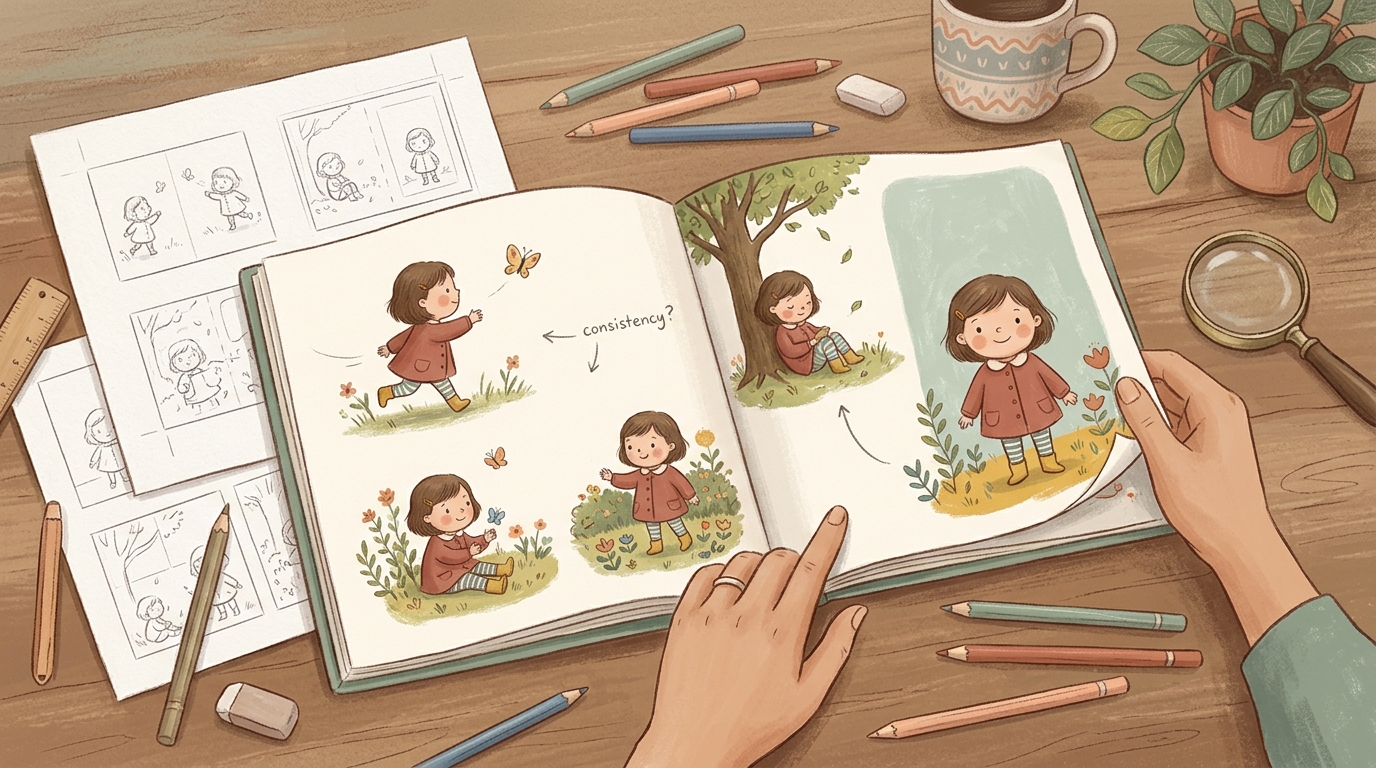
So you finished your first picture book and something feels off. Probably nothing fatal. Most first-timers trip over the same handful of common children's book self-publishing mistakes, and almost every one has a one-line fix. Here they are, in the order they tend to bite.
What's the biggest mistake first-time picture book makers make?
Your character changes from page to page. Page one, she's a round-cheeked girl with a red coat. Page seven, she's got a different face, longer hair, and the coat went orange. Kids notice this faster than adults do, and it quietly breaks the spell.
This is the one mistake worth obsessing over, because it's the one readers feel without being able to name it. A drifting character reads like twelve artists drew twelve different kids. The fix isn't to write longer descriptions every page (that barely helps). It's to lock the character once and reuse that, instead of rolling the dice each page. More on how in the consistency guide.
The mistakes, and the one-line fix for each
- Character drift. She doesn't look like herself by the end. Fix: build the character once and have every page inherit her, rather than re-describing her each time.
- Too many words. A picture book isn't a novel with pictures. If the text says what the art already shows, cut it. Let the illustration carry half the story.
- Wrong page count. Most picture books land near 32 pages for printing and pacing reasons. Plan to that, not to wherever your story happens to stop.
- Trim and bleed trouble. Art that runs to the edge needs bleed, or the printer trims into your picture. Get this right before you fall in love with a full-page spread.
- Mixed styles. A watercolor page next to a flat cartoon page next to a 3D one reads as amateur. Pick one style and hold it for the whole book.
- Skipping the read-aloud. If you never read it out loud, you won't catch the tongue-twister line or the page turn that lands flat. Read every page to a real kid, or to your wall.
Why does "just write a better prompt" not fix the character problem?
Because each generated image has no memory of the last one. You can write a paragraph describing your hero's freckles and you'll still get a slightly different kid, because the tool is starting fresh every single time. Detail helps a little. It does not hold a face across 32 pages.
The structural fix is a persistent cast: you build the character (look, palette, the red coat) one time, and every page pulls from that same source. You stop describing and start directing. That's the whole idea behind Storybench: you author the words, the cast you built once keeps the character consistent, and you never type a style word. A few of the pitfalls above, drift, mixed styles, the print-ready export, are handled for you by design, which leaves you free to fuss over the parts that are actually yours.
What about the boring publishing stuff?
It catches people too. Metadata typos, a cover that's gorgeous on screen and muddy in print, a file that gets rejected on upload. None of it is hard. All of it is easy to skip when you're tired and just want to hit publish. Run a checklist before you do (yes, even, especially, the consistency check: does your character look the same on every page?).
FAQ
How long should my first picture book be?
Aim for around 32 pages of story, which is the common length for printing and a young attention span. Your first one can be shorter. Short and finished beats long and abandoned.
Do I need to draw to avoid the art mistakes?
No. The art mistakes (drift, mixed styles) are about consistency, not drawing talent. A tool that locks one cast and one style across the whole book prevents both without you picking up a pencil.
What's the single fastest thing I can fix today?
Read the whole book out loud. You'll catch clunky lines, too-many-words pages, and weak page turns in one sitting, for free.
Where do I find the print specs like trim and bleed?
Your print-on-demand platform (KDP, for most people) publishes them. The point is to read them before you design, not after, so your art is built to fit.
First books are supposed to be a little rough. The trick is fixing the mistakes readers actually feel and shrugging off the ones they don't. When you're ready to make yours with the character locked from page one, come try it. Bring the story. We'll keep the kid looking like herself.