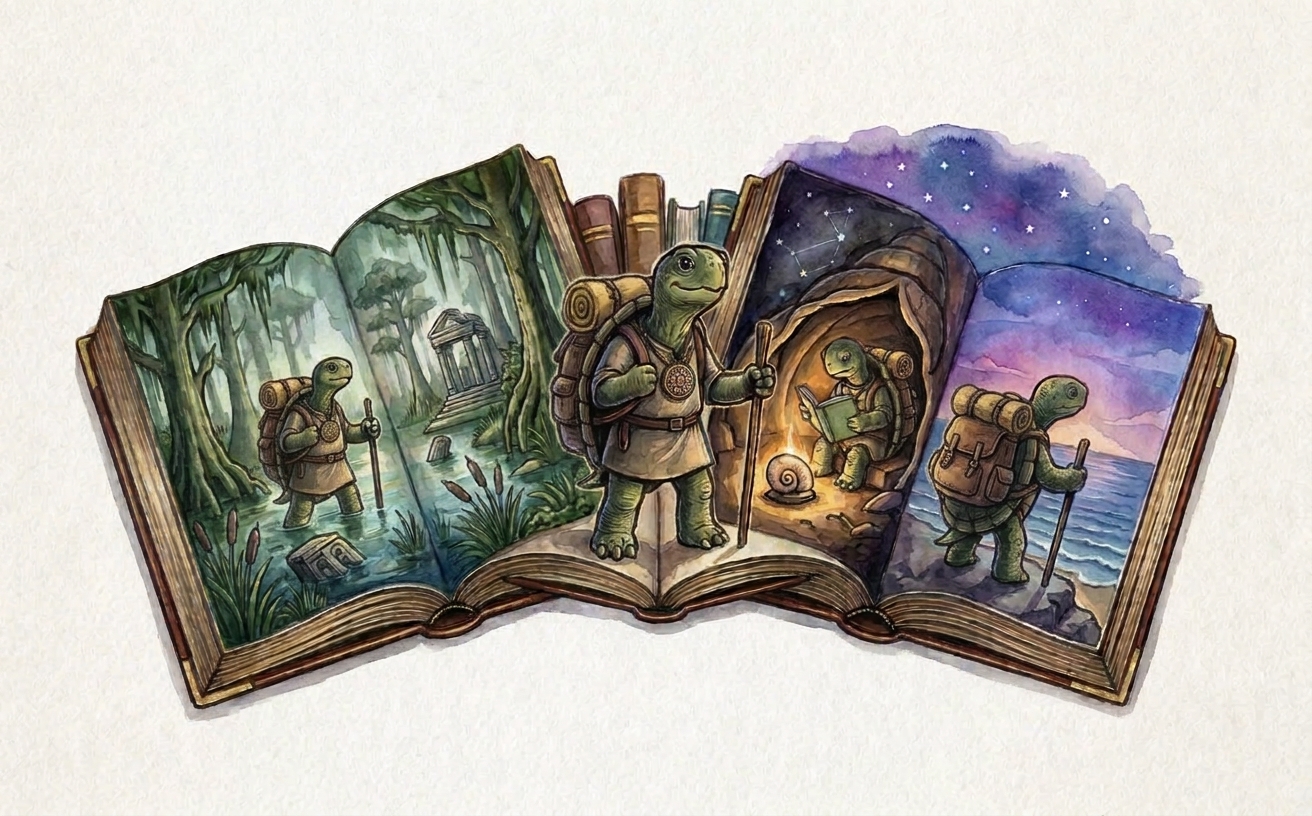
Keeping a character consistent across one book is hard enough. Keeping the same character consistent across a whole series, book after book, is the real test, and it's where most indie authors quietly give up. The way through isn't redrawing your hero from scratch each title. It's building your cast once and carrying it over, so book two starts from the same locked-in character book one ended on.
Why a series is the harder problem
Within a single book, you at least have your last page to glance at. Across books, the thread is even easier to drop. You finish title one, walk away for a month, come back to make title two, and now you're trying to reconstruct exactly what your hero looked like from memory and a few old pages.
That's how series drift sneaks in. The kid who was the star of book one shows up in book two a little off, a slightly different face, a warmer red, a touch older, and suddenly your "series" reads like two unrelated books that happen to share a name. Readers come back for a character they recognize, and recognition is exactly what drift destroys.
The cost of re-establishing a character every book
Think about what beloved series actually run on. Kids don't return to the Gruffalo or to Elephant & Piggie for the plots. They return for the characters, the same ones, looking and sounding like themselves every single time. That recognition is the whole franchise.
Now picture doing that the hard way: re-describing your hero from scratch at the start of every new book, re-rolling the dice on her face, hoping she lands close enough to last time. Best case, it's slow. Worst case, she drifts and the recognition breaks. Either way you're paying the setup cost again and again, on every title, forever. That's a tax on the exact thing that makes a series work.
Now someone's going to say a careful author just keeps good notes and stays consistent by hand. Maybe, for book two. By book five, across a cast of recurring characters, with a year between titles? Good luck. Discipline doesn't scale; reuse does.
How reuse changes the economics
Here's the shift. If your cast persists, you don't re-establish anyone. The hero you built for book one is the same hero in book two, and three, and ten, automatically. The setup cost is paid once, at the start of the whole series, not once per title.
Which flips the math in your favour: your second book is faster than your first, because the hard part (inventing and locking the cast and world) is already done. The work moves from re-building characters to telling new stories with them. That's the compounding payoff of building a story world once, and it's the difference between making one book and running a series.
How this works in practice
In Storybench, your characters, settings, and props live in a cast you build once. A World locks its illustration style when you create it, so every page and every book inside it shares the same look by design. Start a new title in that World and it inherits all of it, the cast, the style, the consistency, with nothing to re-describe.
So book two's hero is book one's hero. Same face, same palette, same gap tooth, same style. You spend your energy on the new adventure, not on rebuilding the kid who's having it. (For the world-building side of this, see build a story world once.)
Common questions
How do I keep a character consistent across multiple books?
Reuse the same saved character instead of recreating it for each title. When your cast carries over from book to book, the character keeps the same look automatically, so a series stays recognizable across every title.
Why do characters drift between books in a series?
Usually because each book re-establishes the character from scratch, often months apart. Small differences creep in every time, and across several titles they add up until the character no longer matches.
Does a series get easier to make as it goes?
It can, when the cast and world are reused. The expensive part is building them the first time; after that, each new book inherits everything, so the work shifts from setup to storytelling.
One good character can carry a shelf of books, but only if she stays herself across all of them. When you're ready to build a cast once and reuse it for title after title, see what we made for creators or get started. Build her once. Bring her back forever.