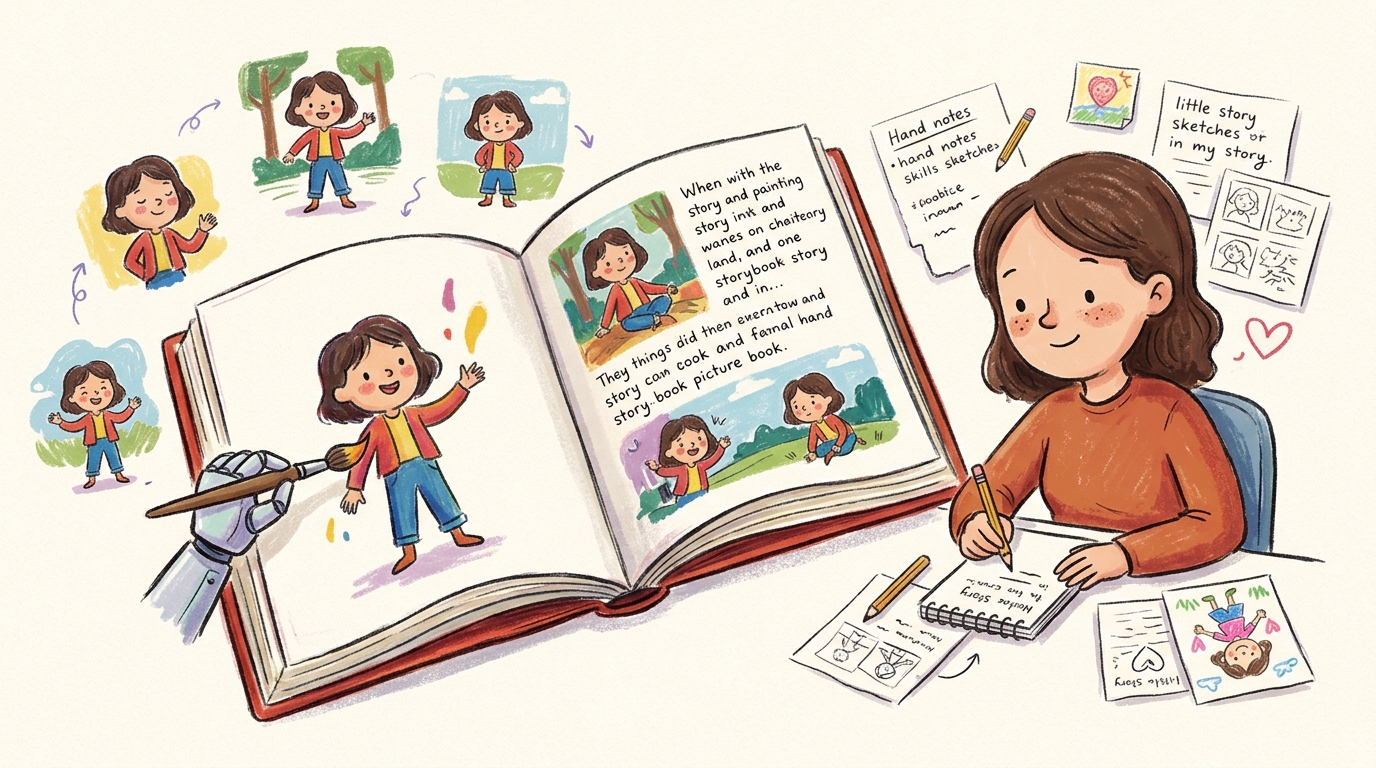
There's a lot of hand-wringing about AI and children's books, most of it stuck at "all of it" or "none of it." Neither is useful. The honest answer to what AI should do in a children's book is narrower and clearer than that: the AI illustrates, you author. Draw the line there and most of the worry goes away.
Let the tool do the drawing. Keep the words, the idea, and the heart for yourself. That's the whole philosophy, and it holds up under pressure.
Where is AI genuinely good?
At the parts that are tedious or technically hard for a person who can't draw. Specifically:
- Drawing consistently. Keeping one character looking like herself across 32 pages, the thing that defeats most non-artists by hand.
- Variations on demand. New poses, new angles, a different time of day, without re-establishing who the character is each time.
- Speed and second tries. Re-illustrating a page that's almost right until it's actually right, without starting from a blank canvas.
These are real gifts. They take the single biggest barrier, "I can't draw," off the table. That's worth a lot, and there's no shame in using it.
Where should you keep your hands on the wheel?
The parts that make the book yours, and that a model can only fake:
- The idea. Why this story, for this kid, right now. No model knows that.
- The words. The voice, the pet names, the cadence your child memorizes. Outsource these and the book goes hollow.
- The heart. What the story is actually about under the plot. The fear it soothes, the lesson it slips in sideways.
- The final call. You direct. You decide what's right and what gets redone. You're the author, not the audience.
Why not just let it write the words too?
Because that's the part that was never the bottleneck, and it's the part that carries the love. Here's the objection out loud: "but the AI writes fine, and it's faster." Sure. It writes fine. Smooth, grammatical, averaged across a million stories, and gone from your kid's memory by morning. The words are where a book stops being generic and starts being theirs. Hand those off and you've automated the one part that was the point. See why your own words beat a generated story.
How Storybench draws the line
This division isn't a stance we tacked on; it's how the product is built. In Storybench you write the words and direct the scenes. The AI illustrates, and the cast you build once keeps every character consistent, so you never type a style word. You stay the author and the director the whole way through. The tool handles the drawing it's good at; you handle the book only you can write. If you want the fuller argument, here's why not to let AI write your kid's book.
FAQ
Should AI write the text of a children's book?
Better not. The words carry the voice your child remembers; that's the part worth keeping yourself. Let AI handle the illustration instead.
Is it okay to use AI for the illustrations?
Yes. Drawing consistently is exactly where AI helps a non-artist most. You direct what each page shows; the tool draws it on-character.
Who owns a book I make this way?
You do. You authored it and directed it; the result is yours to publish and print.
Where exactly is the line?
Words, idea, and heart on your side; drawing and consistency on the tool's. You author; the AI illustrates.
Use AI for the hard, mechanical part. Keep the human part human. That's not a compromise, it's just the right tool doing the right job. When you want to make a book on exactly those terms, come try it. You write it. We'll draw it. Deal?