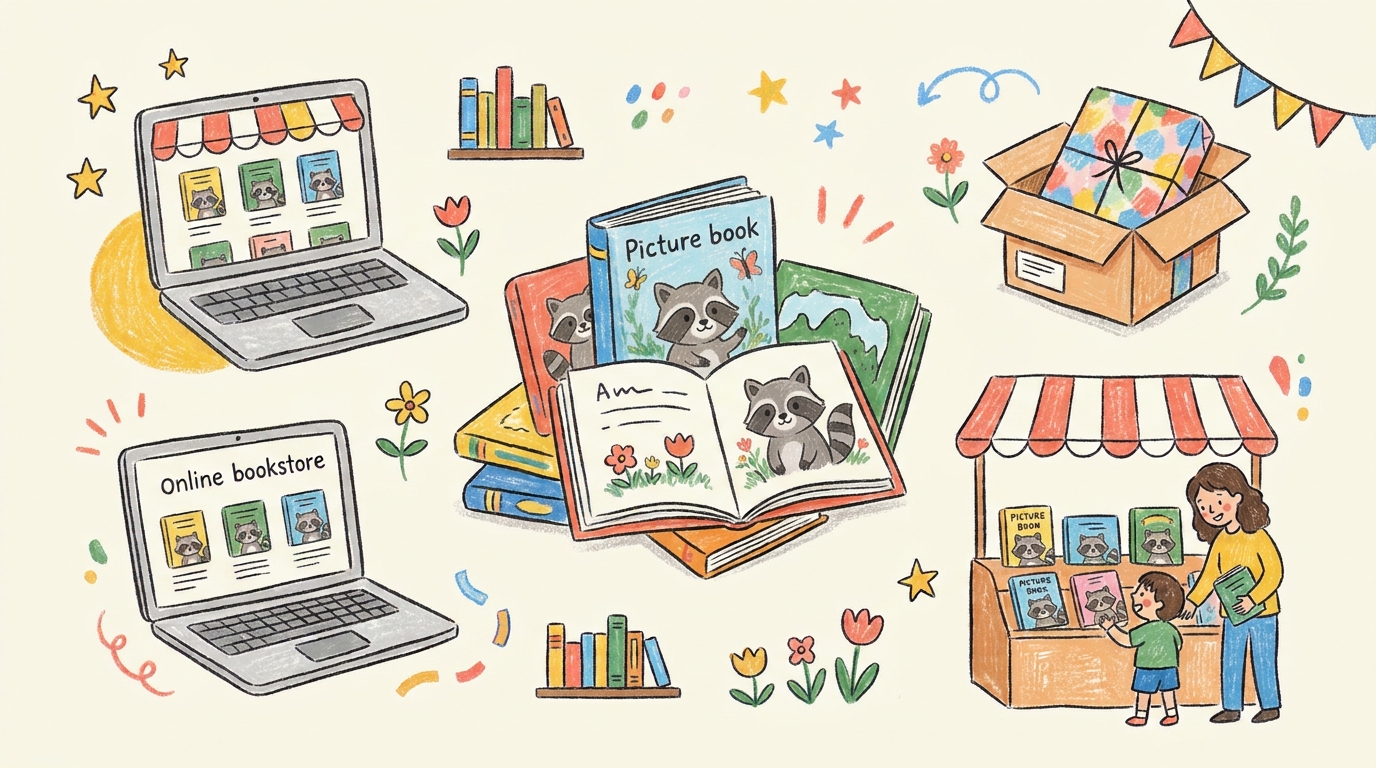
Wondering where to sell a self-published children's book once it's done? Amazon KDP is the obvious shelf, and a good one, but it's not the only one, and for a picture book it's often not the most profitable. The honest answer: sell where your readers already are. For most indie authors that's a mix of KDP for reach, your own site or Etsy for margin, and in-person events for the kind of sales that actually move a kids' book. Here's each channel, fairly.
A quick note before we start: platform fees, terms, and features change, so treat any specific number as TODO: verify against the platform's current page before you commit.
What are the main places to sell a children's book?
There are really five, and most authors use two or three of them at once. Run through them and notice which fits how you like to work.
Amazon KDP (print-on-demand + Kindle). The default, and for good reason: enormous traffic, no inventory, prints and ships a paperback only when someone buys one. Best for: discoverability and reach with zero upfront print cost. The trade-offs: thin royalties on full-color picture books (color printing eats the margin), you don't own the customer relationship, and you're one tap from a million competitors. Most authors start here and treat it as the searchable shelf, not the profit center.
IngramSpark (bookstores + libraries). The route to the rest of the trade: physical bookstores, libraries, and schools order through Ingram's distribution catalog, which KDP doesn't reach the same way. Best for: an author who wants a real shot at shelves and library systems, and who'll do the outreach to make it happen. The trade-offs: a setup fee per title (TODO: verify current fee), more print-spec rigor, and listing somewhere is not the same as selling there (you still have to pitch the buyer). Many authors publish to both KDP and IngramSpark and let each do what it's good at.
Etsy (print copies + digital downloads). A marketplace full of people already shopping for personal, handmade, giftable things, which is exactly the buyer for a custom or niche kids' book. Best for: personalized books, themed or seasonal titles, and selling a digital edition (a printable PDF or an ebook) at near-pure margin. The trade-offs: you handle fulfillment for physical copies (print, pack, ship) unless you sell digital, plus listing and transaction fees (TODO: verify). The upside is real margin and a gift-minded audience.
Your own website (sell direct). A simple shop page (or a tool like Shopify, Gumroad, or Payhip) where you sell the ebook, the printable, or print copies you fulfill yourself. Best for: keeping the most money per sale and, more importantly, owning the customer, so you can tell them about your next book. The trade-offs: no built-in traffic. You have to bring the readers (your email list, your socials, your school visits). This is the long game, and it compounds.
In person (markets, fairs, school visits, local shops). The quietly best channel for children's books, and the one authors skip. A craft market table, a school book fair, a reading at the local library, a consignment shelf at the independent bookshop down the road. Best for: actually selling copies (a parent who watched you read to their kid will buy the book on the spot) and building the word-of-mouth that online can't manufacture. The trade-offs: it doesn't scale, you carry stock, and you have to show up. But the conversion rate beats every algorithm.
So which one should you choose?
Don't choose one. Pick the smallest mix that matches your energy:
- Want maximum reach, minimum hassle? KDP, and stop there for now.
- Want margin and a gift audience? KDP for search plus Etsy or your own site for the people who'll pay for something special.
- Want bookstores and libraries? Add IngramSpark and do the outreach.
- Want the highest conversion of all? Get the book in your hands and sell it to real humans at fairs and school visits.
Now, someone's going to say that's a lot of shelves to manage. It is less work than it sounds, because it's the same book everywhere. Which is the whole point of the next bit.
One book, every shelf, without redoing the work
The thing that makes selling everywhere realistic is having the right files ready to go. A print-ready PDF goes to KDP and IngramSpark and print-on-demand. An EPUB goes to ebook stores and digital sales. And image posts go straight to your socials to promote any of it.
That's exactly what Storybench hands you: a print-ready PDF for KDP and print-on-demand, an EPUB, and social images, all from the same book. Build it once, then send the right file to each shelf instead of rebuilding it for every store. See how it works, or the spec-level walkthrough of a print-ready PDF for KDP.
And once it's listed, you still have to tell people. That's the next post: how to market a self-published children's book with no ad budget.
Frequently asked questions
Can I sell my children's book somewhere other than Amazon?
Yes. IngramSpark reaches bookstores and libraries, Etsy and your own site sell print or digital direct, and in-person events (markets, fairs, school visits) often convert best of all. Most authors use a mix.
Where do self-published children's books make the most money?
Usually direct sales (your own site or Etsy) and in-person events, because you keep more per copy and own the customer. KDP gives the most reach but the thinnest margin on full-color picture books.
Do I need IngramSpark if I'm already on KDP?
Only if you want bookstore and library distribution, which KDP doesn't reach the same way. Many authors publish to both. Check each platform's current terms before you decide (TODO: verify).
Can I sell the same book in print and as an ebook?
Yes, and you should. A print-ready PDF covers print-on-demand and direct print sales; an EPUB covers ebook stores. From Storybench you can publish both formats from the same book, so you're not redoing the work.
The best shelf is the one where someone's already looking for your book. Usually that's more than one. When yours is ready to sell, start your book and make the files do the running around for you.