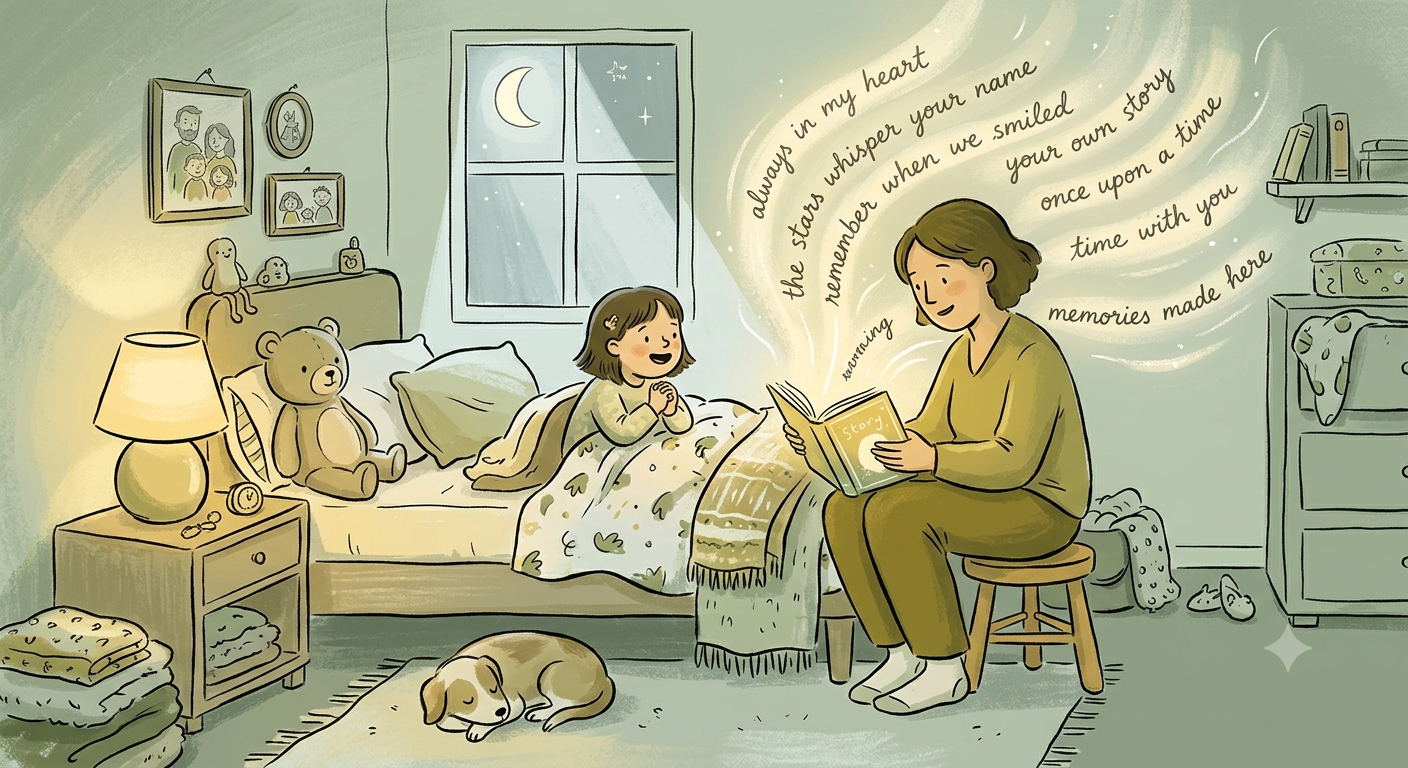
Think about the book your kid asks for every single night. You can probably recite it. So can they, ahead of you, correcting you when you skip a word. That's the thing about writing a personalized story for your child: the lines get memorized. They get carried. And the question worth asking before you make one is whose lines you want your kid carrying around for the next ten years.
The drawing can be the AI's job. The words should be yours. That's not a slogan, it's a practical observation about what kids actually keep.
Why do the exact words matter so much to a kid?
Because children don't love a book in summary. They love it in cadence. They love the specific way a line lands, the funny word, the pause before the page turn, the rhythm they can feel coming. They memorize the exact text and get genuinely upset if you paraphrase it. The words aren't a delivery mechanism for the plot. To a small kid, the words basically are the book.
So a story written for your child isn't really about the plot either. It's about the pet name only your family uses. The inside joke about the dog. The way you actually talk at bedtime, soft and a little silly. That texture is the whole gift.
Can't a model just write something sweet?
It can write something smooth. Pleasant, grammatical, instantly forgettable. What it can't write is the line your kid will quote back to you at breakfast three years from now, because that line is made of details only you have: the nickname, the made-up word for the thing under the bed, the small private joke. A model averages across a million bedtime stories. You're not trying to be average. You're trying to be theirs.
Here's the objection out loud: but my writing is plain. Good. Plain is what works for a five-year-old. "Goodnight, little bear" in your voice beats a perfectly-balanced paragraph in nobody's. You don't need fancy. You need true.
So what's the AI actually for?
The part that genuinely is hard. Drawing your child as a consistent character, page after page, so the kid in the book looks like the kid in your house from the cover to the last page. That's the work most parents can't do by hand, and it's exactly the work a tool should take off your plate.
In Storybench you build your child as a cast member once, their face, their hair, the dinosaur pajamas, and every page inherits that, so they stay themselves throughout. Then you write the lines. You. The pet names, the bedtime cadence, the inside jokes go in as your words, and the illustration carries the look. You author; the AI illustrates. That division is the whole point, and it's how the brand is built. See why we say don't let AI write your kid's book for the longer version.
FAQ
Do I have to be good at writing to do this?
No. Write the way you'd say it out loud at bedtime. For a young child, your plain, real voice beats polished prose every time.
How do I make my child the star without it looking generic?
Build your child as a reusable character once, so they look the same on every page, then write the story around the specific details of your actual kid. Real details are what keep it from feeling like a template.
Can I print it as a keepsake?
Yes. You can publish a print-ready PDF for print-on-demand and an EPUB, so the book your child memorizes is also one you can hold.
What does the AI write, then?
Nothing you don't want it to. The model illustrates. The words stay yours, which is the part your kid will actually remember.
One day your kid will quote a line back at you and you'll realize it stuck for good. Make sure it's a line you wrote. When you're ready to build the book in your own words, with your own kid as the star, come try it. Bring the bedtime voice. We've got the rest.