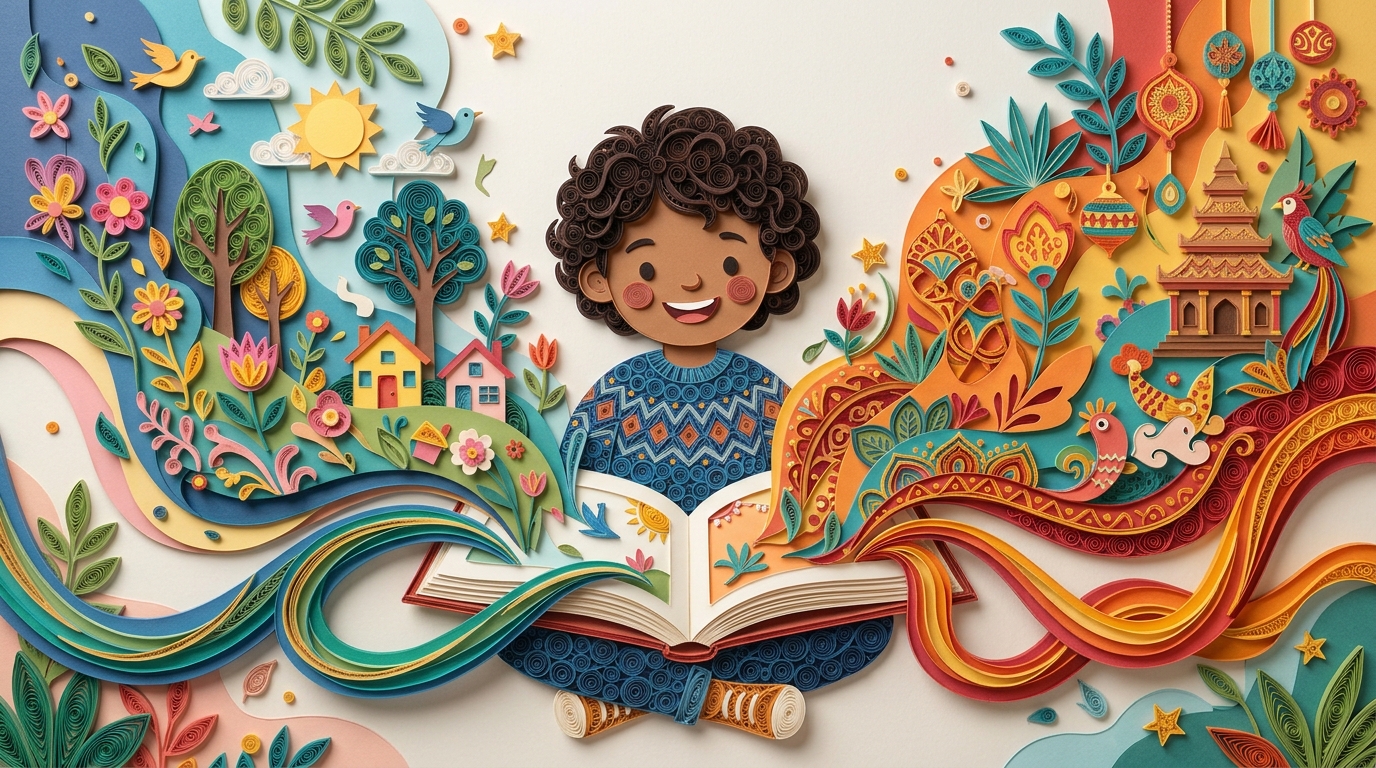
A bilingual children's book is one story told in two languages, usually both on the same page, so a child can hear it in one and read along in the other. The reason to make one is simple and not at all small: you want your kid to grow up holding both of their languages, and there aren't enough good books that do that for your family. The most important thing to get right isn't the layout. It's that both languages sound like a real person, you, and not like a translation app. That's the part worth protecting.
Let's walk through it.
Why make a bilingual book at all?
Because a heritage language lives or dies in the small, warm moments, and a book is one of the warmest. For a dual-language home, it's bedtime in both tongues. For a classroom, it's the kid who finally sees their home language on the page next to the school one, treated as equal, not as a footnote. For grandparents an ocean away, it's a story they can read to the grandchild in the words they know.
A child who sees their language honored in a book they love hears the message underneath it: this part of you matters. That's the whole point.
How do you lay out two languages on a page?
There are two common approaches, and one is usually better for young readers:
- Both languages on every page. The two versions of the line sit together on the same spread, one above the other or side by side. Best for picture books and shared reading: a parent can read one, then the other, and a child connects the two without flipping anywhere. This is the friendliest for little kids.
- Mirrored (one language each way). One language reads front to back, the other reads from the other cover inward, meeting in the middle. Charming and very intentional, but trickier to design and to read aloud in one sitting. Better for older kids or keepsake editions.
For a first bilingual book, put both languages on the page. Keep the lines short so the page doesn't get crowded, and let the illustration carry the rest. (A picture is the one part of the book that needs no translation.)
How do you keep both languages sounding natural?
You write both versions yourself, or with someone who truly speaks the language, and you never settle for a machine's flat literal swap. This is where so many bilingual books go wrong: one language is alive and the other is a stiff, word-for-word rendering that no actual speaker would say. Kids and grandparents catch it instantly.
A few honest guidelines:
- Write each language in its own voice. Don't translate one into the other. Tell the same little story twice, each time the way you'd actually say it. The idioms, the rhythm, the pet name for the dog, those don't translate, they get re-told.
- Read both aloud. If a line sounds like homework in either language, it's not done. A bilingual book is double the read-aloud, so it has to sound good twice.
- If you only half-speak one language, get a real human to help. A fluent relative, a teacher, a friend. The warmth of a true speaker is exactly what a generator can't fake.
Now, someone's going to say a translation tool would be faster. Sure. And it would sound like one. The reason to make this book yourself is that your kid will memorize these exact lines in both languages, the way you say them. A machine can produce two correct texts. It can't produce yours. (More on that in don't let AI write your kid's book.)
Where does the tool fit, then?
Exactly where it should: the drawing, not the words. You write both languages in your own voice. Storybench keeps the illustrations consistent across every page (the same character, the same world, page one to the end), so the art unifies a book that's carrying two languages at once. Then you publish it as a print-ready PDF or an EPUB, the same as any other book.
The division of labor stays honest: you author, in both languages, and the AI illustrates. See how it works, or read why you don't have to be "a writer" to do this. It's just as true in two languages as in one.
Frequently asked questions
What is a bilingual children's book?
It's one story told in two languages, most often with both versions on the same page so a child can hear one and follow along in the other. It's a common way to support heritage languages and dual-language homes and classrooms.
Should both languages be on the same page?
For young readers, usually yes. Both languages on the page lets a parent read each in turn and helps a child connect the two. Mirrored layouts (one language each direction) suit older kids and keepsake editions but are harder to read aloud in one go.
Should I just use a translation app for the second language?
Better not. A literal machine translation tends to read stiff and unnatural, and fluent speakers notice. Write each language in its own voice, or work with a real speaker, so both sound like a person and not a tool.
Can I publish a bilingual book in print and as an ebook?
Yes. You can publish a print-ready PDF for print-on-demand and an EPUB ebook from the same book, with the illustrations staying consistent across every page in both languages.
Your kid deserves a book that holds both halves of who they are, in the exact words you'd use. Write those words, in both languages. When you're ready to make it, start your book and let the pictures keep up with you.