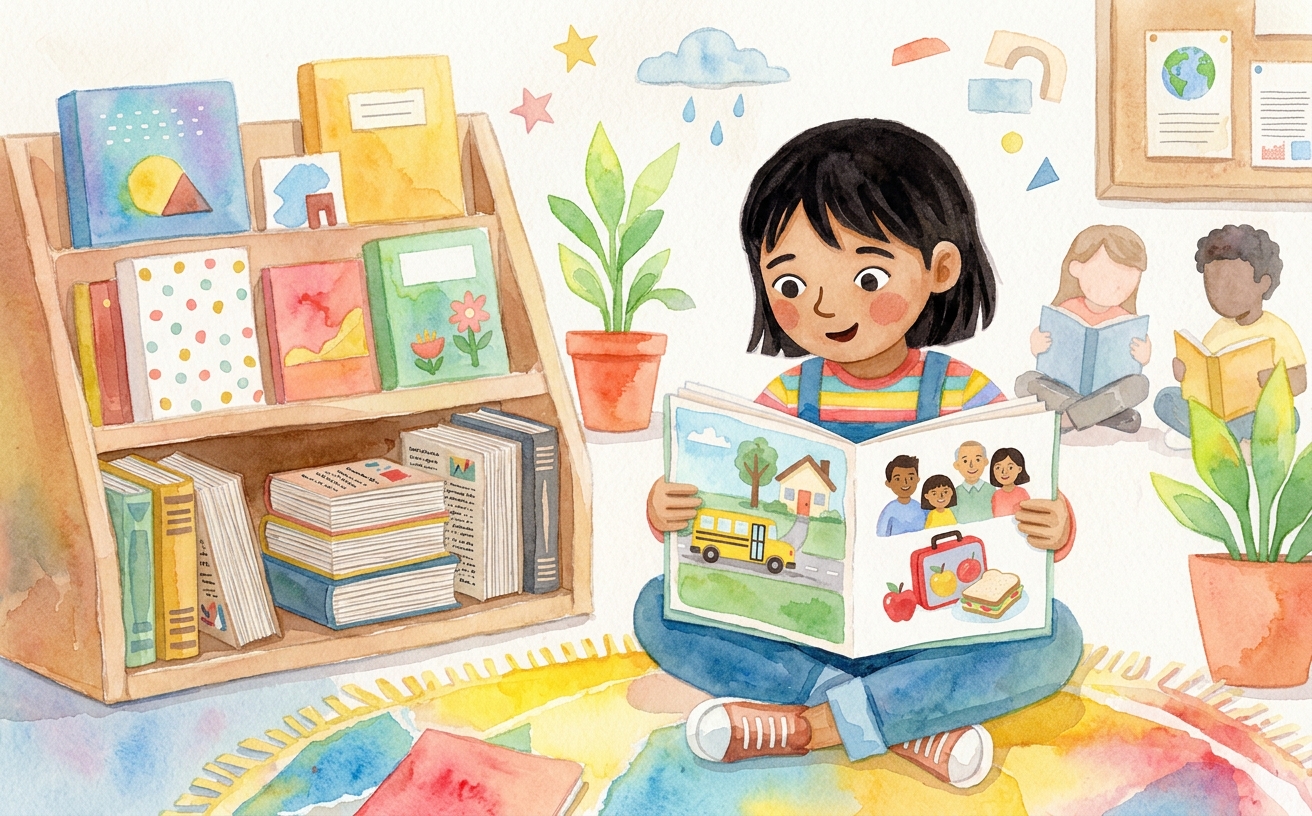
Is there a student on your carpet who is still learning English, and a shelf full of books that are either too babyish or too hard? You're not imagining the gap. Most picture books weren't written for her, her bus ride or her kitchen.
Quick answer: the best picture books for English language learners use short, repeated sentences, a picture on every page that carries the meaning, and subjects the child already knows. You can write that book yourself in an afternoon, built around the student's own routines.
What makes picture books for English language learners work?
Three things show up again and again in the good ones. Repetition gives a new word several chances to land. Pictures let a child understand a sentence before she can decode every word. And familiar content means she's matching a new word to something she already knows, not learning a word and a whole new idea at once.
Colorín Colorado, the bilingual site for educators and families of English language learners, keeps a browsable catalog of picture books to help you find titles for these students. Published books are a great start. But a published book can't know that your student takes the number 12 bus or that her little brother is named Tomás.
That's the gap a book you write fills.
Why write a book about the student's own life?
Because the vocabulary is already hers. "Breakfast," "backpack," "bus," "door." She's lived those words in another language, so the English label is a bridge, not a brand-new mountain.
It also changes how she feels about reading. A child who rarely sees herself in the books at school opens one with her own name on the cover, and something shifts. If that idea sounds familiar, it's the same one behind personalized books for your classroom.
- It's relevant: the words come from her real day.
- It's low-pressure: she already knows what the story says.
- It's rereadable: familiar books get read ten times, and every read is practice.
- It's shareable: she can take it home and read it to family in either language.
How do you write simple text for a language learner?
Keep a pattern and change one thing at a time. Here's a starter method.
- Pick one routine. Morning, lunchtime, walking home. One, not five.
- List six to ten words the student already uses. Ask her, in whatever language works. Draw or point if words don't come.
- Choose a sentence frame. "In the morning, I eat breakfast." "At lunch, I eat rice." Only the last word changes. That's your repetition.
- Write one frame per page. A line or two at most, and nothing on the page that the picture doesn't show.
- Add one small surprise at the end. The pattern breaks: "At night, I read my book." The child hears the change and feels it.
- Read it with her three times. Start with a picture walk (Colorín Colorado's guide to reading aloud to build comprehension recommends pointing out the pictures before you read). Then you read, then you read together, then she reads to you.
Frames that stretch a little
Once the first frame feels easy, add a second: "I see a ___. It is ___." Colors, sizes and places slip in naturally. Don't rush it. A book that's slightly too easy teaches more than one that's slightly too hard, because the child finishes it and wants another.
Should the book have words in two languages?
Often, yes, and it can be as light as a small label under the picture. If you speak the child's home language, or a parent, aide or older student does, put the home-language word beside the English one: "la puerta / door." It tells her that her first language is welcome here, and it lets families read along.
If you don't speak the language, ask the family to supply the words. That's a conversation worth having anyway. One caution: keep the home-language labels short and consistent. Two full sentences on a page is two books.
What should the pictures do?
This is where most homemade books stumble. The picture has to carry the meaning. If the text says "I eat breakfast," the page should show a bowl, a spoon and a child, not a vague sunrise. Use one clear subject per page, a plain background, and the same child looking the same way every time. A student following a story shouldn't have to wonder whether the girl on page four is the girl from page two.
Consistency matters more here than in almost any other book. That's the part many teachers drop out of: nobody on staff has the time to draw the same child eleven times.
How can you make the illustrations if you can't draw?
Storybench is a picture-book maker for people who want to write it themselves, with characters that stay consistent on every page. You write the words, you describe the student (or a character like her), and each page you illustrate inherits that look automatically. You direct, the AI illustrates, and you can re-illustrate any page until it fits the sentence. Writing and laying out the book is free, and credits are only spent when pages are illustrated. Details are on our pricing page.
If you want the classroom version of this idea, our teachers page lays out how a cast and a World get reused from one book to the next. Making a second book for the same student takes a fraction of the first, because her character already exists.
A few cautions before you hand it over
- Check the picture against the sentence out loud. If you have to explain a page, fix the page.
- Ask the student and her family before you use her real name or photo-like details, and keep the book in the classroom or home unless they say otherwise.
- A book is one more tool, not an assessment. It won't replace your ESL specialist, and we won't pretend it measures progress.
- Match the length to the child. Our post on writing picture books for reading aloud helps you judge how much text a page can hold.
Frequently asked questions
What are the best picture books for English language learners?
Look for short repeated sentences, one clear picture per page and familiar everyday topics. Catalogs like Colorín Colorado's picture-book list are a good place to browse, and a book you write about the child's own routine often beats any shelf pick.
Can I make an ESL picture book for just one student?
Yes, and it's often the most useful kind. A book about one child's real morning, street or family uses words she already lives with, so every page is easy to understand and worth rereading.
How long should a picture book for a beginner English learner be?
Short. Start with a handful of pages built on a single sentence frame, then grow it. If the child finishes happily and asks for another, the length was right.
Should I include the child's home language in the book?
It helps when you can do it accurately. A short home-language label beside the English word signals respect and lets families read along. Ask the family for the words if you're unsure.
Do I need to know how to draw to make one?
No. You write the sentences and direct the pictures, and an illustration tool can draw them. What matters is that each picture clearly matches its sentence.
Start the student's first book
Pick one routine, one frame and one child. Then start your book and build her character once. By the second page she'll be in it, looking like herself, and the carpet suddenly has a book that's hers.