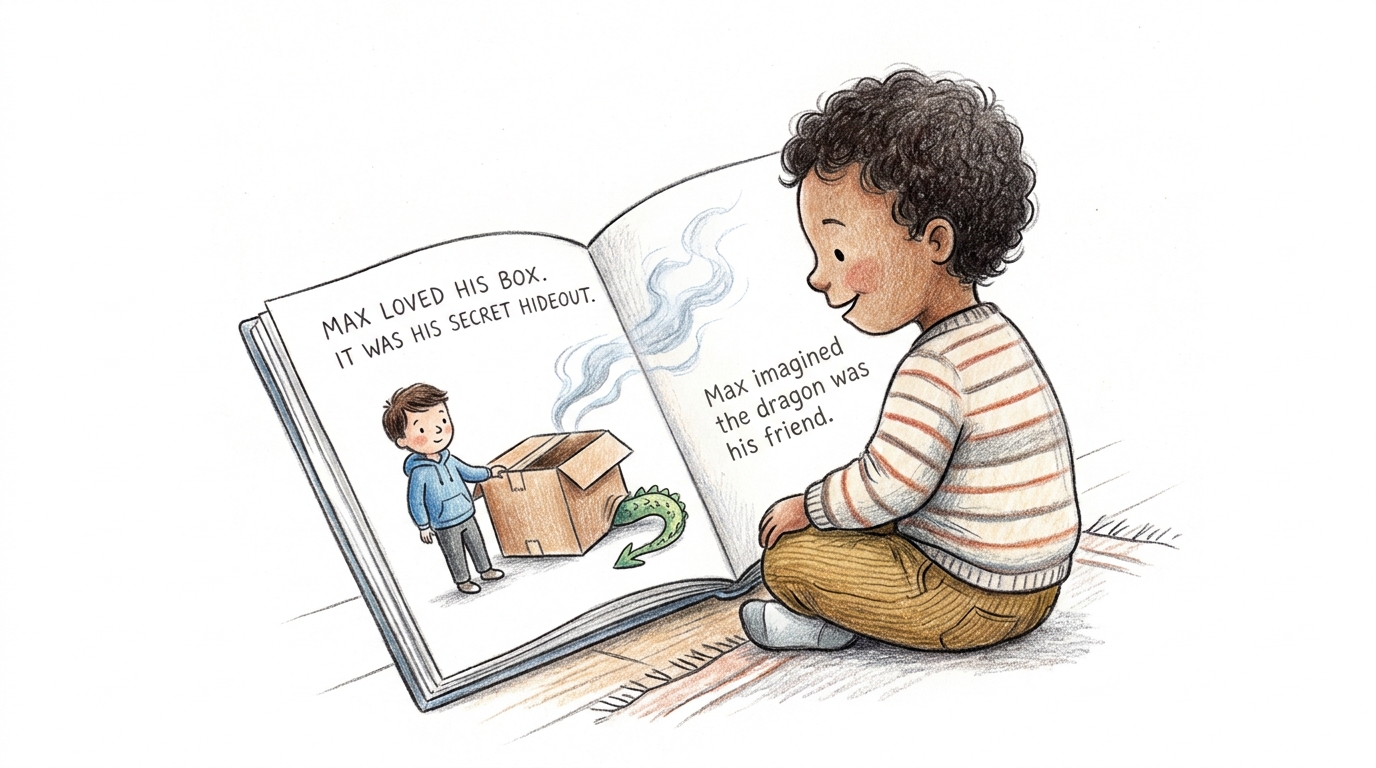
You've heard "show, don't tell" a hundred times. In a picture book it means something sharper than in a novel, because half the showing isn't even your job. The picture does it. So the rule becomes: don't write what the reader can already see. If the illustration shows a kid scowling with his arms crossed, the words "Max was angry" are dead weight. The picture said it. Your words get to do something else.
Text and art are a duet, not an echo. That's the whole craft of it.
What does "show, don't tell" mean when the picture does the showing?
In prose, you have to build the scene with words: the slumped shoulders, the slammed door. In a picture book, the illustration builds the scene. So you stop narrating the visible and start adding what the picture can't say on its own: the thought, the joke, the turn, the line that flips what we're looking at.
Picture shows a boy frozen at the top of a tall slide. Don't write "the slide was very high and Sam was scared." We can see all that. Write "Sam had climbed all the way up here on purpose. He was beginning to regret that." Now the words add the wry inside scoop the picture couldn't. That's the counterpoint.
When should the words and the picture disagree?
Some of the best picture-book moments come from text and art saying different things on purpose. The words insist everything is fine; the picture shows the dog covered in spaghetti and the kitchen on fire. That gap is the joke. Kids love it because they're in on something the narrator pretends not to see.
You can't pull that off if your text just describes the picture. The space between what's said and what's shown is where humor, irony, and surprise live. Leave that space open.
How do you trim the words that repeat the picture?
Draft your page text, then look at what the illustration will obviously show, and delete every word that doubles it. A quick pass:
- Cut visible descriptions. Hair color, what they're wearing, the weather, where they are. The art handles all of it.
- Cut named emotions when the face shows them. "She smiled happily" becomes nothing; let the smile be the smile.
- Keep what only words can carry. Names, thoughts, dialogue, time, the twist, the thing about to happen on the next page.
What's left after that cut is usually a line or two. And a line or two is exactly the right size for a picture-book page.
So who decides what the picture shows?
You do, and this is the part we love. You don't draw it, but you direct it. You decide that this page shows Sam frozen at the top of the slide, with that exact look on his face, while your words wink about the regret. That description, the scene you're calling for, is its own kind of writing. It's you telling the illustration what to carry so your words are free to do the other half.
Which is the honest division of labor behind Storybench: you write the page and describe the scene; the illustration brings that scene to life consistently, page after page. The drawing can be the tool's job. Deciding what's shown and what's said, and writing the said part in your own voice, stays yours. (For the nuts and bolts of calling a scene, see writing a page description.)
Don't write what we can see. Write what we can't.
Frequently asked questions
Should picture-book text ever describe the scene?
Rarely, and only for things the picture genuinely can't show: a character's private thought, a sound, the passage of time, or a deliberate contrast with what's pictured. If the illustration already shows it, the words should move on.
How few words per page is too few?
There's no minimum. Some of the strongest spreads have no words at all and let the picture land alone. Trust the art to carry a beat by itself when the moment calls for silence.
Is "show don't tell" different for very young kids?
The principle holds, but board books for the youngest readers lean even harder on the picture and use the fewest, simplest words. Match the word load to the reader's age, and let the art do more for the littlest ones.
Write the half only you can write
Let the picture do its half. Spend your words on the half it can't reach, the voice, the wink, the heart, and write that part like you. When you're ready to put text and art together, start your book and try a page where the words and the picture are doing two different jobs. (Want more craft? Start with our guide to writing a children's picture book.)